Edward Korthals & the Making of the Wirehaired Pointing Griffon
Now Booking
Spring 2027 Litter
Pepper · Dam
Walker · Sire
✓Health-tested, CHIC-certified parents
✓AKC, UKC, & NAVHDA registered
✓Titled, proven hunting bloodlines
✓Raised in-home for 10 weeks
Limited spots · Screening required
Most breeds came together slowly, shaped by whole regions of farmers and poachers and shepherds who never wrote anything down. The Wirehaired Pointing Griffon is different. It had an author. One man, working with a clear picture in his head of the dog he wanted, assembled it from scratch inside a single human lifetime — and then died young, at forty-five, before he could see how completely it would take. His name was Eduard Karel Korthals, and if you run a Griffon today, you are running his idea.
That is a rare thing in the dog world, and it is worth understanding, because Korthals did not breed for the show ring or for fashion. He bred for the rough, cold, brushy, wet ground of the European lowlands and the work a hunter needs done there: a close-working dog that points, tracks, and retrieves on land and water, with a harsh coat that shrugs off bramble and weather. Everything your Griffon is good at traces back to a deliberate decision he made before the United States had finished settling its own frontier. For the wider map of where this all leads, start at our heritage and registries overview; here we stay with the founder.
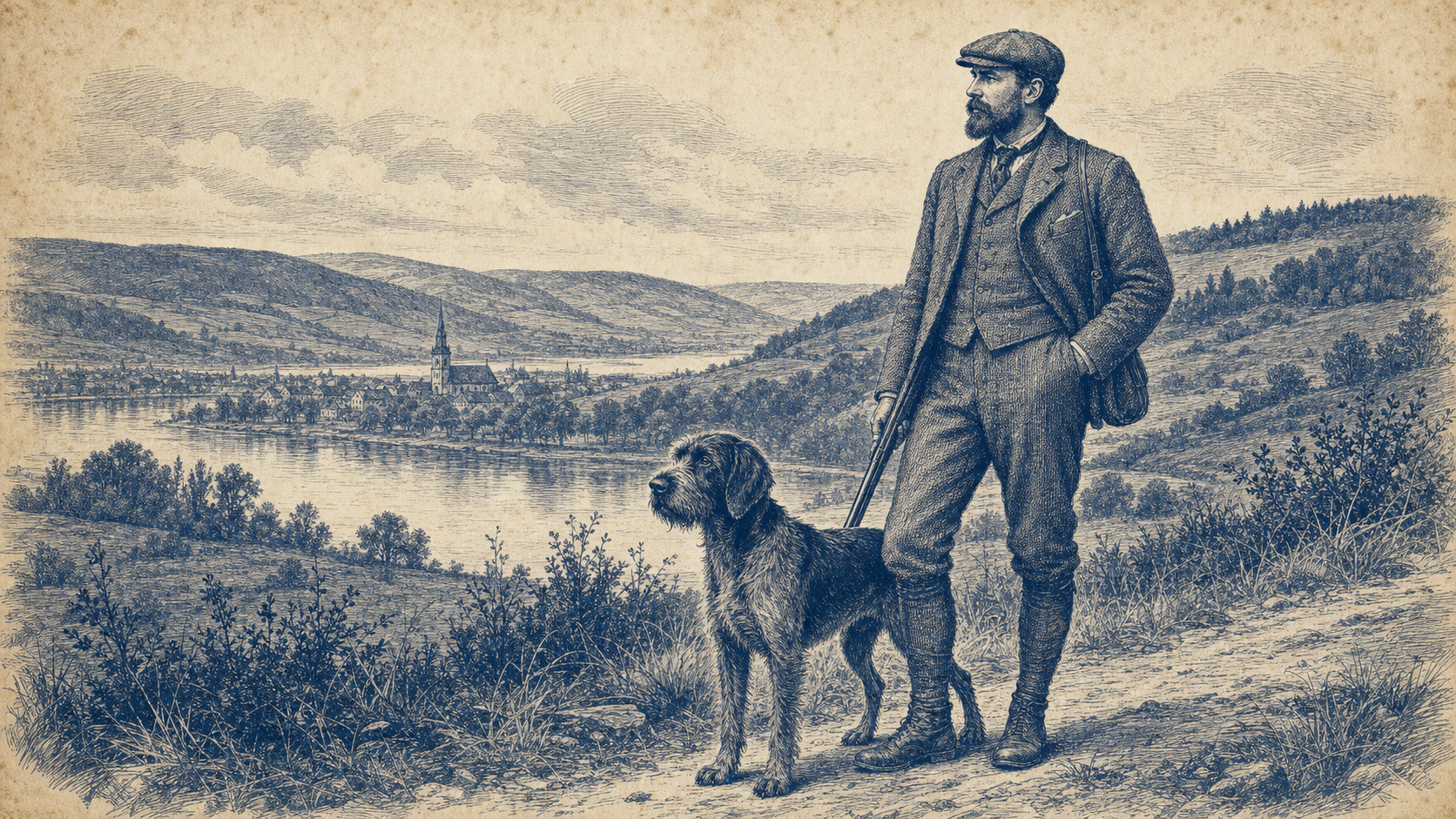
The founder’s vision: a close-working, weather-proof gun dog for the rough lowland country of Continental Europe.
The Man Behind the Breed
Korthals was born in Amsterdam in 1851, the son of a wealthy Dutch businessman, which mattered: breeding a dog from nothing takes money, kennels, and the freedom to fail for years. He was, by every account, obsessed with hunting dogs from boyhood. By his early twenties he had begun the project that would consume the rest of his life — building a single, fixed, breeding-true wirehaired pointing breed out of a varied pool of rough-coated Continental gun dogs (American Kennel Club).
Although Korthals was Dutch and began his work in the Netherlands, he soon moved to Germany, eventually settling at the kennels of Prince Albrecht zu Solms-Braunfels and later working in the Rhine country, where he did the bulk of his breeding. He died at Biebesheim am Rhein in 1896. This is the root of the breed’s geographic identity crisis: a Dutch founder, a German workshop, and — as the next article explains — a French custodianship that endures to this day (Wikipedia: Wirehaired Pointing Griffon).
Interactive Tool
Which test or trial should your dog do next?
Answer a few quick questions about your dog’s age, training and your goals. We’ll point you to the right next step — NAVHDA, an AKC hunt test or field trial, a UKC or NSTRA title, or the conformation ring.
The Foundation Dogs
Korthals did not pull his breed out of thin air. He started from a working pool of rough- and wire-coated Continental dogs and selected ruthlessly toward his ideal. Breed historians point to a small group of foundation animals — the dogs whose names anchor the very base of the studbook and from which the modern Griffon descends. Korthals kept careful records, and his early breeding stock is traditionally remembered as the handful of patriarchs and matriarchs that fixed the type.
Why “a few foundation dogs” matters
When a breed traces to a small founding group assembled by one breeder, two things follow. First, the type sets quickly and stays remarkably consistent — which is why Griffons a century apart still look and work alike. Second, the gene pool is narrow, which is exactly why modern responsible breeders lean so hard on health testing and thoughtful pairings. The breed’s great strength and its great vulnerability come from the same root.
From this base, Korthals wrote a breed standard, promoted the dog tirelessly across Europe, and recruited a circle of fellow breeders — the so-called “Korthals men” — who carried the program forward in multiple countries. By the time of his death the breed was established well enough to survive its founder, which is the truest test of any breeding program.
One Dog, Two Names
Because the breed was developed by a Dutchman in Germany and then adopted as a national treasure by France, it ended up with more than one name. In much of Europe — and among some American enthusiasts — it is the Korthals Griffon, honoring its author. In the United States, the American Kennel Club recognizes it as the Wirehaired Pointing Griffon, the name it was formally given in 1916 (AKC breed page).
They are, for practical purposes in the AKC world, the same dog. (There is one important wrinkle — a later American splinter group adopted the “Korthals Griffon” name for a separately bred line that is not AKC-registerable as a Wirehaired Pointing Griffon. We untangle that fully in the national club article.)
Why Korthals Still Matters in Montana
Stand in a sagebrush draw below the Bridgers some October morning and watch a Griffon work, and you are watching a Dutchman’s idea, a hundred and fifty years old, doing exactly what it was designed to do on ground he never saw. That is the quiet marvel of a well-made breed: the vision outlives the man and crosses an ocean intact. The dog that points your roosters is, in the most literal sense, a working antique — and one still being improved by the breeders who keep faith with the standard he wrote.
The next chapter is the one most Americans miss entirely: how the breed left German hands and became, of all things, French. Read how France saved and spread the Griffon — it explains the registry that still governs the breed worldwide. Then, when you are ready to think about your own dog’s papers, our guide to choosing a registry brings it home to North America.
How this article was made: researched and written with AI, then reviewed, edited, and published by Daniel Hartzheim of Griffons Out West in Belgrade, Montana.
Korthals’ biography and the breed’s origin are drawn from the American Kennel Club breed history and published breed records. Early-studbook details vary between sources; where exact foundation-dog names or dates are disputed, we have kept to what the breed clubs and registries themselves publish. Always confirm specifics with a breed club before citing them as fact.