Here is a thing that confuses nearly every American who falls for this breed. You buy a dog developed by a Dutchman in Germany, you register it with an American club under an English name — and then you discover that the breed’s official homeland, its governing registry, and its largest population are all French. The Wirehaired Pointing Griffon is, by international decree, a French breed. How did that happen? And why does it still matter to a hunter in Montana?
It matters because France did something no other country did: it kept faith with the dog when the dog’s own birthplace let it drift. While the breed thinned out in Germany and got tangled up in well-meaning experiments in America, the French held the line on the standard, the studbook, and the rule that a Griffon must prove it can hunt before it earns the right to be called a good one. If your Griffon still points and retrieves like its great-great-grandparents did, you have French stubbornness to thank. This is the second half of the origin story we begin in the Korthals article.
France took custody of the breed’s standard, studbook, and working ethic — and never let go.
The Club That Took Custody (1901)
The institutional story begins in 1901, when Charles Prudhommeaux founded the Club Français du Griffon d’Arrêt à Poil Dur — the French national breed club for the wirehaired pointing griffon (Club du Griffon Korthals France; AWPGA History). This was only five years after Korthals’ death, and it gave the breed something it badly needed: a permanent, organized home willing to defend it.
Half a century later, on June 8, 1951, the club paid formal tribute to the breed’s creator by renaming itself the Club Français du Griffon d’Arrêt à Poil Dur Korthals — adding his name to keep his memory alive. That same year the FCI formalized the official international designation of the breed as the Griffon d’Arrêt à Poil Dur Korthals (Club du Griffon Korthals France; Korthals Griffon United States).
Interactive Tool
Which test or trial should your dog do next?
Answer a few quick questions about your dog’s age, training and your goals. We’ll point you to the right next step — NAVHDA, an AKC hunt test or field trial, a UKC or NSTRA title, or the conformation ring.
How a German-Made Dog “Became French”
The pivot point was the two World Wars. After WWI — the French-language record dates it to roughly 1919, when national clubs across Europe reorganized — the breed’s center of gravity shifted decisively to France (French Wikipedia). After WWII, the French club took the step that settled the matter for good: it took custody of the original studbook (the G.S.B.) and formally became the FCI parent club for the breed, with France designated the country of patronage (Korthals Griffon United States; FCI Nomenclature No. 107).
The Pointing Dog Blog put the whole tangle about as well as anyone has: the Griffon “was created mainly in Germany by a Dutchman working under the patronage of an Anglophile German prince… But France has the largest population of Griffons and the largest and most influential Griffon club. It is also considered by the FCI to be the parent country of the breed” (Pointing Dog Blog).
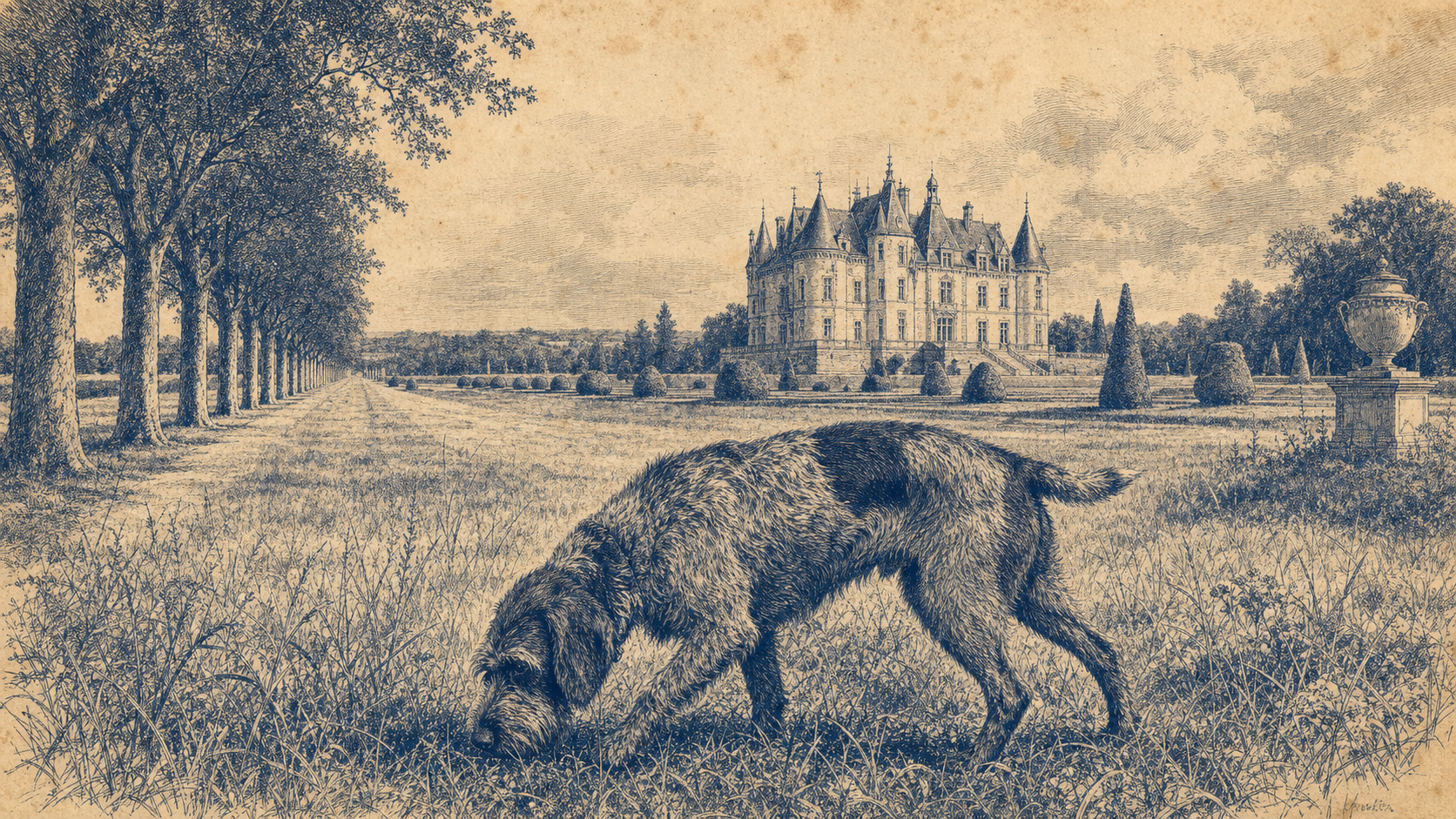
Dutch vision, German workshop, French custody
The cleanest way to hold the whole history in your head: a Dutchman (Korthals) had the vision, he did the breeding work in Germany, and France took permanent custody of the standard and studbook — which is why the FCI calls it a French breed today. Three countries, one dog, no contradiction.
The French Innovation: Prove It Can Hunt
France’s most important contribution was not paperwork — it was a philosophy. French breeders insisted on performance-based selection: a Griffon should not be bred from, or fully recognized, until it has demonstrated real hunting ability in the field. Korthals himself had established field trials as a requirement, and the French built an entire ladder on that foundation.
That ladder — the famous cotation grading system, the confirmation exam, and the European trial circuit that ties it all together — is genuinely unlike anything in American dog sport, and it deserves its own treatment. We give it the full deep-dive in the French system: cotation, confirmation, and the European circuit. The French club operates under the Société Centrale Canine, France’s national kennel club, which coordinates with the FCI on the international standard (Club du Griffon Korthals France).
The Standard That Never Really Changed
One measure of good custodianship is restraint. The first formal breed standard, signed by sixteen Griffon breeders in 1887, has “never been modified” in its fundamental character — the modern FCI standard, last updated in 2023, remains essentially identical (AWPGA Timeline; Korthals Griffon United States). The FCI’s own historical note credits Korthals with renewing and improving the old “oysel dog” “by inbreeding, selection and training without any addition of foreign blood” (FCI Standard 2023, via Korthals Griffon US). That last phrase — without any addition of foreign blood — becomes important later, when we tell the story of an American club that broke that rule.
What This Means for an American Owner
You will hunt your Griffon under American rules, with American clubs, on American birds. But it helps to know that the dog at your side answers to a standard guarded in France, and that the very thing you love about the breed — that it is a worker first and a show dog second — is a French inheritance, defended for over a century.
From here, two roads. If you want to understand the European grading machine in detail, read the cotation deep-dive. If you are ready to think practically about your own dog’s North American papers, our guide to choosing a registry lays out AKC, UKC, NAVHDA and the rest — and explains why we register our own pups the way we do.
How this touches our pups
Our dam, Whiskeytown’s Pepper, is almost entirely French-pedigreed — only her dam was born stateside, her sire imported from France. His SCC pedigree is loaded with top cotation grades: an ÉLITE B (4/6) sire (RIRI des Grandes Origines) out of a 6/6 dam, over a generation studded with 6/6 dogs and HD-A hips. The French selection rigor described above isn’t theory for us — it is the foundation of our dam line. See the full breakdown in our cotation deep-dive.
How this article was made: researched and written with AI, then reviewed, edited, and published by Daniel Hartzheim of Griffons Out West in Belgrade, Montana.