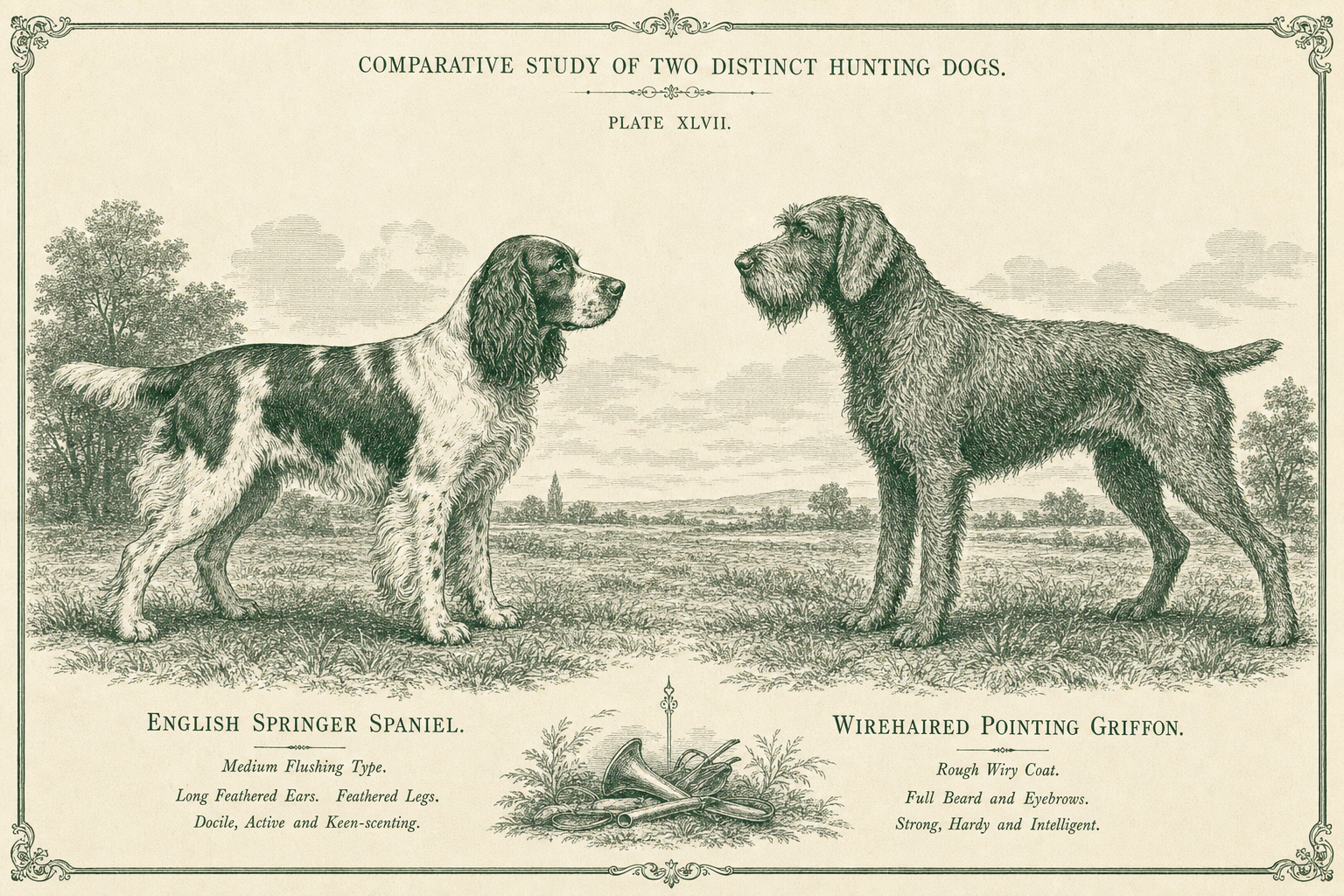
The English Springer Spaniel is one of the great hunting dogs of the world — not because it does what a pointer does, but because it does something entirely different, and it does it brilliantly. The Springer quarters ahead of the hunter in a windshield‑wiper pattern, drives through the thickest cover without hesitation, and when it hits bird scent, it doesn’t stop. It flushes. Hard. The bird goes up fast, the hunter fires, and the Springer is already marking the fall and on its way to retrieve. It’s action hunting at its most immediate.
The Wirehaired Pointing Griffon is a pointing dog. It finds birds and holds them — crouching into its feline, belly‑to‑ground point and freezing until you walk in for the shot. Completely different contract. Understanding flushing versus pointing is the foundation of this comparison, and it matters more than any personality trait or coat difference between these two dogs.
Wirehaired Pointing Griffon vs. English Springer Spaniel — pointing versatility meets the classic flushing partnership.
Flushing vs. Pointing: The Fundamental Difference
When a Springer works a pheasant‑holding brushpile, it moves through the cover relentlessly until it pushes the bird into the air. The flush is the goal — “Springers are supposed to flush birds hard,” as the ESSFTA hunting style guide states directly. The hunter must be ready the moment the bird clears the cover, because there is no pause. Gun up, shoot fast.
When a WPG works the same brushpile, it locks onto point the moment scent intensity tells it the bird is there. The hunter walks in, flushes the bird deliberately, and fires at a more controlled moment. For mixed cover where birds hold tight, the point gives you time. For heavy, dense cover where pointing breeds struggle to push through, the Springer’s drive is extraordinary.
The Project Upland ESS profile notes that the Springer’s flushing style is “the polar opposite of a pointer’s — no holding, no waiting, pure action and partnership.” Neither style is superior. They suit different cover, different game, different hunters. See the full context in our gundog comparison series.
What the Springer Does Exceptionally Well
The Springer’s ability to work cover that stops most pointing breeds is genuinely extraordinary. Dense alder thickets, cattail sloughs, deadfall — the Springer is fearless in exactly the terrain that frustrates a dog trying to hold a point. The quartering pattern keeps hunter and dog in constant communication, with the docked tail flagging never stop moving as a real‑time scent indicator. “A feathered metronome of enthusiasm” is how it feels in the field.
Retrieving is also the Springer’s strong suit — fast, efficient, with a soft mouth that’s a core breed trait. Field Springers must complete back‑to‑back water retrieves to earn AKC titles. As of 2022, AKC permits Springers in retriever hunt tests, a recognition of how capable they are in the water retrieve role. Blood trailing isn’t a formal Springer competency, but the breed does use foot scent when trailing — head down, seeking scent along the ground — a different style from a continental breed’s air‑scenting track.
Interactive Tool
Which test or trial should your dog do next?
Answer a few quick questions about your dog’s age, training and your goals. We’ll point you to the right next step — NAVHDA, an AKC hunt test or field trial, a UKC or NSTRA title, or the conformation ring.
Temperament & Trainability
The Springer’s personality is captured perfectly in a single word the breed’s literature returns to constantly: merry. These dogs are enthusiastic, social, fun‑loving, and want to be your best friend at all times. “Fun‑loving, aim to please, want to be your best friend all the time” is the Project Upland description. Biddability is high — it’s actually a component of what makes them useful hunting dogs; a flusher that won’t stop on command is dangerous.
Field‑bred Springers are very high‑energy and intense. A bored Springer is a destructive Springer. The breed matures rapidly and shows birdiness early in field lines, which makes structured early training both important and rewarding. Recall and stop‑whistle work are priorities — a flusher must work within gun range or it’s flushing birds out of reach.
The WPG is softer and somewhat more forgiving of training inconsistencies. Both breeds reward positive methods. The Springer is arguably the more immediately enthusiastic training partner — that eagerness to please translates well in short, reward‑based sessions. The WPG’s “let the dog think it thought of it” approach to training takes slightly more patience but produces exceptional results in the field.
The Field vs. Show Split
The English Springer Spaniel has one of the most severe field‑vs‑show divides of any breed. According to the ESSFTA field vs. show FAQ, “the gene pools are almost completely segregated and have been for at least 70 years.” Field Springers are leaner, more athletic, higher‑eared, with shorter coats and a wilder, more functional look. Bench Springers are heavier‑boned with longer, silkier coats and pendulous ears. They look like related but distinct dogs — because functionally, they are. A bench‑bred Springer will not hunt. Seek field-bred or field‑proven lines specifically.
“Springer Rage” — a documented form of idiopathic aggression — exists in some show and bench lines. It’s rare, but worth knowing. It does not appear in field-bred lines with any frequency.
Coat, Grooming & Health
Field‑bred Springers wear a shorter, coarser coat with modest feathering — lower maintenance than the bench coat but still requiring regular brushing to prevent mats. Ears are the breed’s biggest maintenance concern: floppy ears trap moisture after swimming, and ear infections are chronic, expensive, and among the most significant health costs in Springer ownership. Proactive ear cleaning after every water exposure is essential, not optional.
Other health concerns include hip dysplasia (12–19%), elbow dysplasia (12–15%), and PRA. Two DNA tests are available and important: cord1 PRA and phosphofructokinase (PFK) deficiency. Responsible breeders test both. Size is medium: males 19–20 inches, 40–50 lb; lifespan 12–14 years. The WPG’s wire coat requires annual hand‑stripping to maintain texture, while the WPG’s health testing requirements are outlined at the AWPGA health page.
Home Life & Space Needs
Both the Springer and the WPG are affectionate, family‑oriented dogs that need significant daily exercise and do not do well in long daily isolation. The Springer needs 60–120 minutes of vigorous activity; under‑exercised Springers become hyperactive, vocal, and destructive. They’re excellent with children — consistently rated 5/5 on temperament scales with kids and other dogs. They thrive on human contact and do not belong in a kennel as an afterthought.
The Springer’s medium size (40–50 lb versus the WPG’s 50–69 lb) is an advantage in a vehicle or a smaller home. Both dogs suit an active rural or suburban lifestyle. Neither is apartment‑viable for a hunter who wants the dog in peak working condition.
Which Dog Fits You?
Choose the English Springer Spaniel if you hunt heavy cover — dense thickets, cattail sloughs, brushpiles — where a pointing dog has trouble holding a bird and where you want action, flush‑and‑retrieve, and a dog that works tight to the gun in constant partnership. The Springer is also an outstanding choice if pheasant flushing in big grain country is your primary hunting. It’s merry, biddable, athletic, and built for exactly this work. Just buy from verified field lines and commit to ear care.
Choose the WPG if you want a pointing dog — a dog that holds birds while you walk in, that retrieves from land and water, that tracks wounded game, and that handles a duck blind with the same calm disposition it brings to a grouse cover. The WPG’s close‑working, do‑everything versatility is a different tool for a different kind of hunter. If you’ve ever watched a dog lock into a feline crouch over a holding pheasant and thought “that’s what I want,” a flushing breed won’t give you that moment. That’s worth knowing before you choose.
How this article was made: researched and written with AI, then reviewed, edited, and published by Griffons Out West in Belgrade, Montana.