Watch a great English Pointer work open country and you’ll understand immediately why the breed shaped the entire pointing dog world. Nose high, crescent tail driving, feet barely grazing the ground — covering half a mile of prairie at a gallop that looks effortless. The Pointer is the original bird‑finding specialist, the breed that made the concept of a pointing dog famous on two continents. It’s been doing this longer than almost any other pointing breed, and it does it with a style that nothing else quite matches.
The Wirehaired Pointing Griffon is a completely different animal. It works closer, retrieves reliably, tracks wounded game, handles water, and stays connected to its hunter in a way the classic wide‑running Pointer was never designed to do. These two dogs share the pointing instinct and not much else. Understanding the difference matters if you’re trying to figure out which one actually fits the way you hunt.
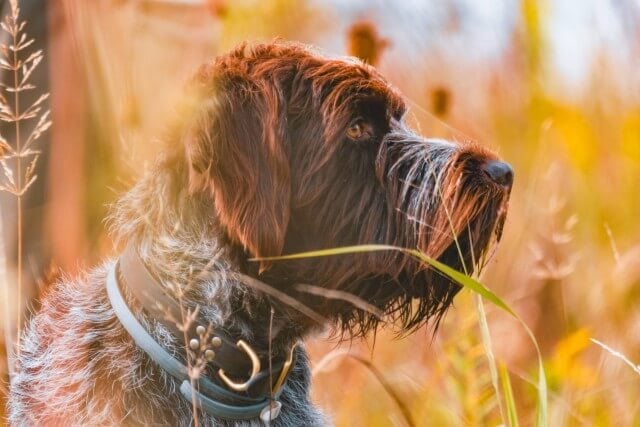
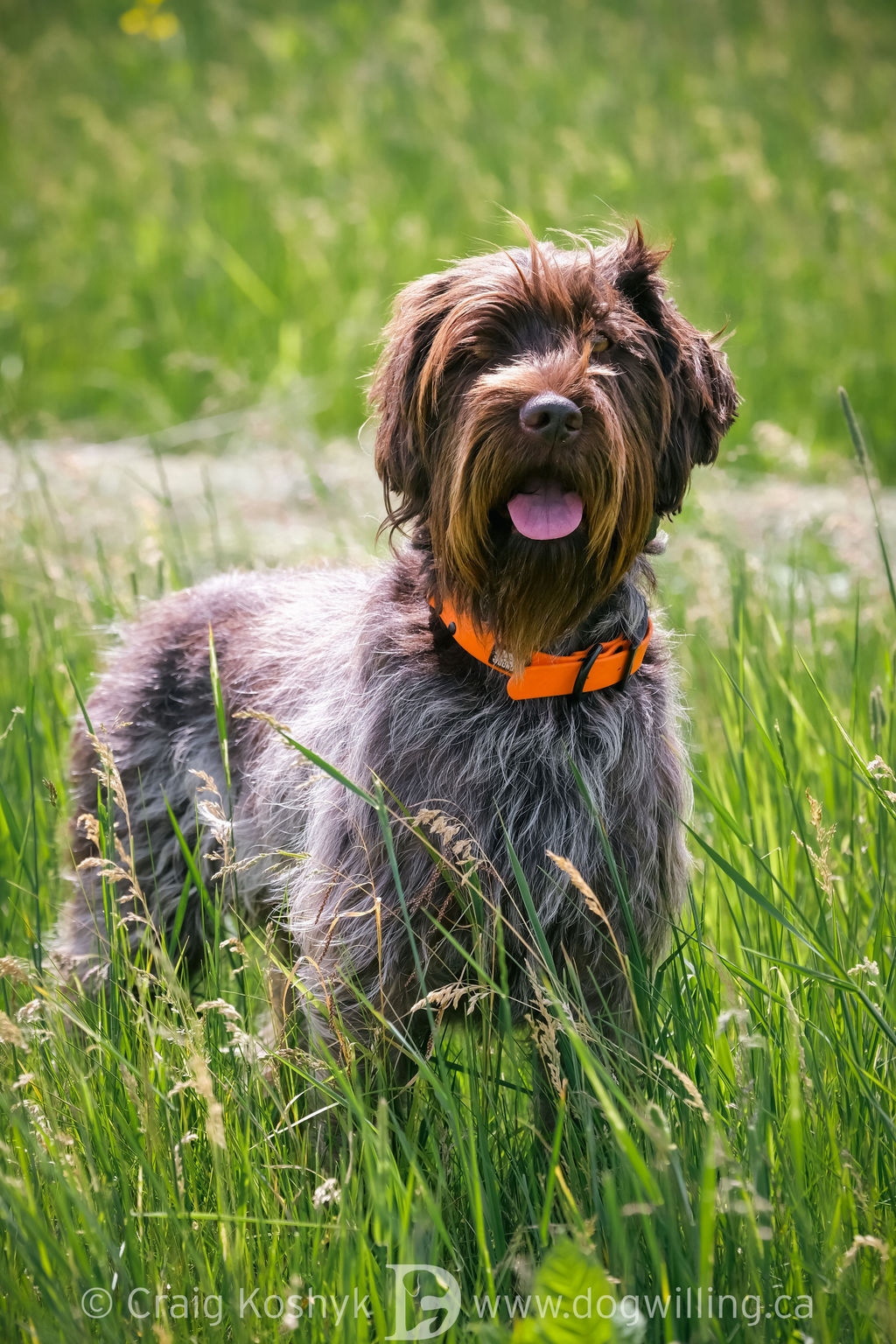
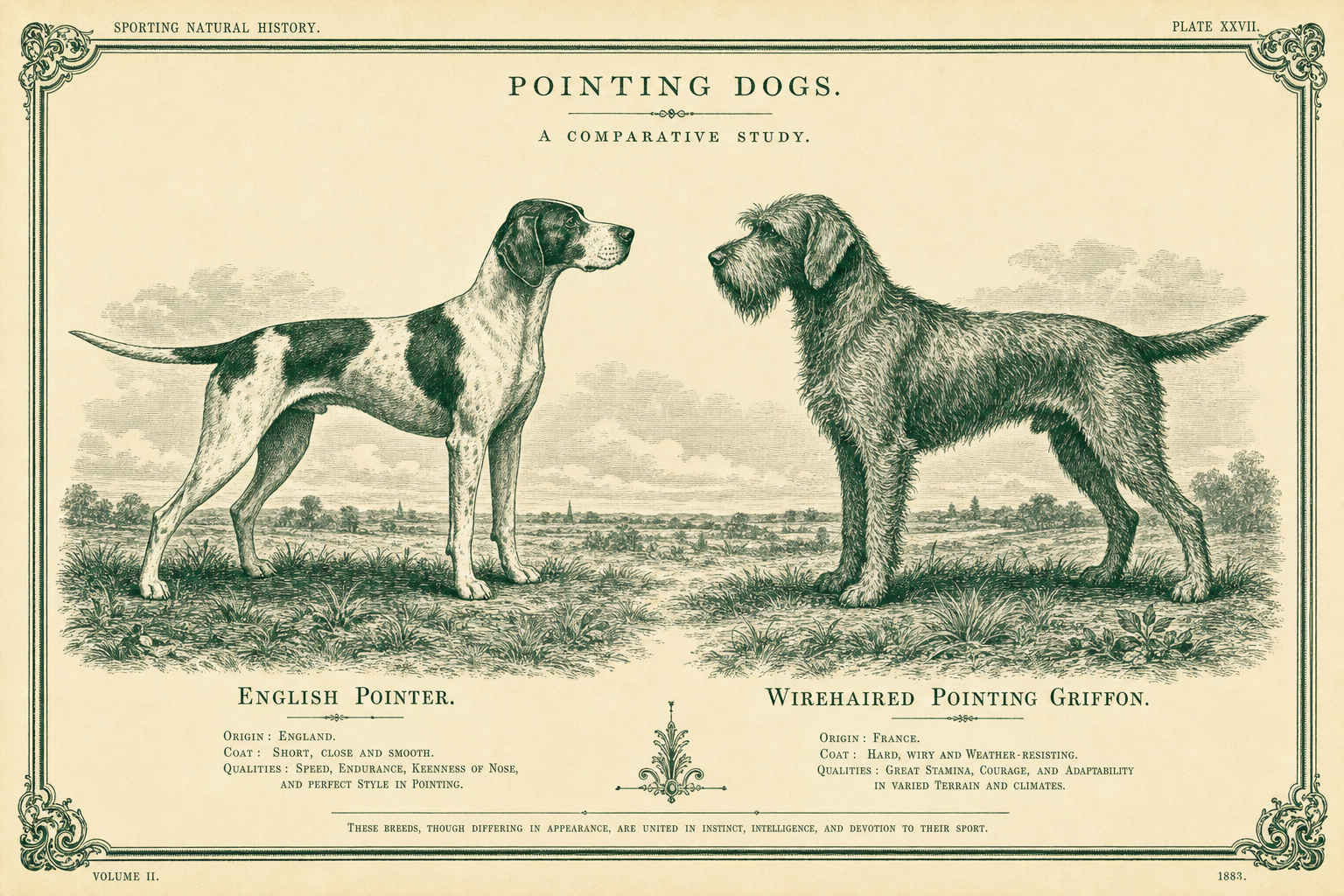
Wirehaired Pointing Griffon vs. English Pointer — close-working versatility meets wide-running upland specialization.
Hunting Style: Specialist vs. Generalist
The Pointer was built for one thing: finding birds in big, open country. According to the Quail Forever English Pointer profile, these dogs hunt “with nose held high to the wind” and cover “ridgelines and draws in quarter‑mile strides.” In many regions, hunters use GPS collars and some hunt from horseback to keep pace. The AKC used the Pointer’s silhouette as its official emblem from 1877 — that’s how central the breed is to the pointing dog tradition.
The Pointer excels on Texas quail flats, Idaho chukar ridges, Montana sharptail prairies, and Alaskan ptarmigan country — wherever the dog can use its legs and nose at full speed. It is a pure upland hunting specialist. It does not retrieve reliably: the PetMD Pointer profile notes that the retrieve “is dubious at best” in many field‑trial lines. Retrieving can be trained, but it is not a genetic priority. Waterfowl work is not part of the Pointer’s mission. Blood trailing is not a core competency.
The WPG, by contrast, is a medium‑range dog that stays closer to the gun, retrieves willingly from land and water, tracks wounded birds and furred game, and handles duck blinds with a calm temperament suited to the work. It’s the walking hunter’s do‑everything dog. The Pointer is the open‑country specialist’s dream. They answer different questions. For a full picture of how versatile breeds compare, see our gundog comparison series.
Interactive Tool
Which test or trial should your dog do next?
Answer a few quick questions about your dog’s age, training and your goals. We’ll point you to the right next step — NAVHDA, an AKC hunt test or field trial, a UKC or NSTRA title, or the conformation ring.
The Pointer’s Signature Trait: Style and Range
It deserves a moment to celebrate what the Pointer does that nothing else does. The point itself is iconic — high‑headed, tail piercing the sky, body frozen with absolute precision. The Project Upland Pointer profile describes seeing the point develop in puppies at 7–8 weeks in strong lines. Sight and scent pointing; no hesitation; pure instinct.
And unlike almost every other pointing breed, the Pointer has largely avoided the show‑ring dilution that has hurt other breeds. Because the Pointer never became a popular pet, hunting genetics remained dominant. The odds of finding excellent working lines are unusually good for a breed this old — a genuine advantage for the serious upland hunter.
Temperament & Trainability
The Pointer is friendly and affectionate at home — it will “seek out affection from any family member willing to oblige” once exercise needs are met. But in the field, the dog is hunting, not socializing. Its intelligence can make it “stubborn and mischievous” without consistent early handling. The Quail Forever profile notes that “training them to hunt for you is the challenge” and that range control must be established early.
The WPG is considerably softer and more handler‑oriented. It responds best to a patient, low‑pressure approach and is widely considered one of the most amateur‑friendly versatile breeds. The Pointer is harder, more independent, and higher‑energy — one of the highest‑energy sporting breeds overall, needing 1–2 hours of vigorous daily exercise. An experienced handler and a GPS collar are both strongly recommended for a Pointer owner.
The Pointer is not as velcro‑dependent as a Vizsla or Weimaraner — it’s more independent than most sporting breeds, which suits some owners. But that independence in the field is the same trait that can make range management a real training task for a first‑time pointing dog owner.
Coat, Grooming & Health
The Pointer’s short, smooth coat is the easiest-grooming option in the entire pointing dog world. A weekly brush is all it needs. No stripping, no undercoat, no beard maintenance. Shedding is low to moderate and seasonal. The coat is a genuine liability only in cold weather — no insulation means late‑season work in cold climates requires a vest or jacket.
Health concerns include hip dysplasia, elbow dysplasia, Von Willebrand’s disease, and deafness (BAER screen recommended). The Pointer is generally described as a tough, healthy breed with few major concerns. Males run 25–28 inches and 55–75 lb; females 23–26 inches and 44–65 lb. Lifespan is 10–12 years, somewhat shorter than the WPG’s 12–14.
The WPG’s wire double coat requires hand‑stripping once or twice a year but sheds minimally and provides excellent field protection in cold, wet conditions. Required health tests — OFA hips, elbows, thyroid, annual ACVO eye exam — are outlined at the AWPGA health page.
Home Life & Space Needs
Both breeds need space, daily vigorous exercise, and an active household. The Pointer needs 1–2 hours of real running per day and is not apartment‑viable. Pointers are good with children — playful and energetic — but high bird‑prey drive means caution around pet birds. Separation tolerance is moderate; they can be destructive without adequate outlets.
The WPG is very similar in space and exercise needs, though slightly less frantically energetic than the Pointer. Both dogs need active, hunting-lifestyle families. Neither is a casual weekend dog.
Which Dog Fits You?
Choose the Pointer if you hunt big, open country — quail flats, chukar ridges, sharptail prairies — and you want the most range, the most style, and the cleanest‑grooming sporting dog money can buy. If you don’t need your dog to retrieve reliably or work water, and you want a proven open‑country specialist with centuries of bird‑finding genetics behind it, the Pointer is extraordinary at what it does.
Choose the WPG if you want a close‑to‑medium‑range dog that points, retrieves from land and water, tracks wounded game, and handles the duck blind with the same dog you take grouse hunting. The WPG is the one dog for everything — a different mission, not a lesser one.
How this article was made: researched and written with AI, then reviewed, edited, and published by Griffons Out West in Belgrade, Montana.
Breed details here are drawn from Project Upland, Quail Forever, and PetMD; every dog varies by line and breeder, so meet the dogs in person before you decide.