If the Wirehaired Pointing Griffon is the steady, capable workhorse of the continental versatile world, the Spinone Italiano is its wise, unhurried older cousin — the one who’s been doing this for centuries and sees no reason to rush. The Spinone is one of the oldest pointing breeds in Europe, wire‑coated like the WPG, and built for the same all‑terrain, all‑species mission. But where the WPG moves at a smooth gallop, the Spinone trots. Where the WPG is eager and handler‑attuned, the Spinone is thoughtful and occasionally independent. These are kindred spirits with a different pace.
If you’re drawn to a wire‑coated versatile dog but wonder whether the Spinone’s famously mellow temperament and methodical hunting style might suit you better, this comparison is for you.
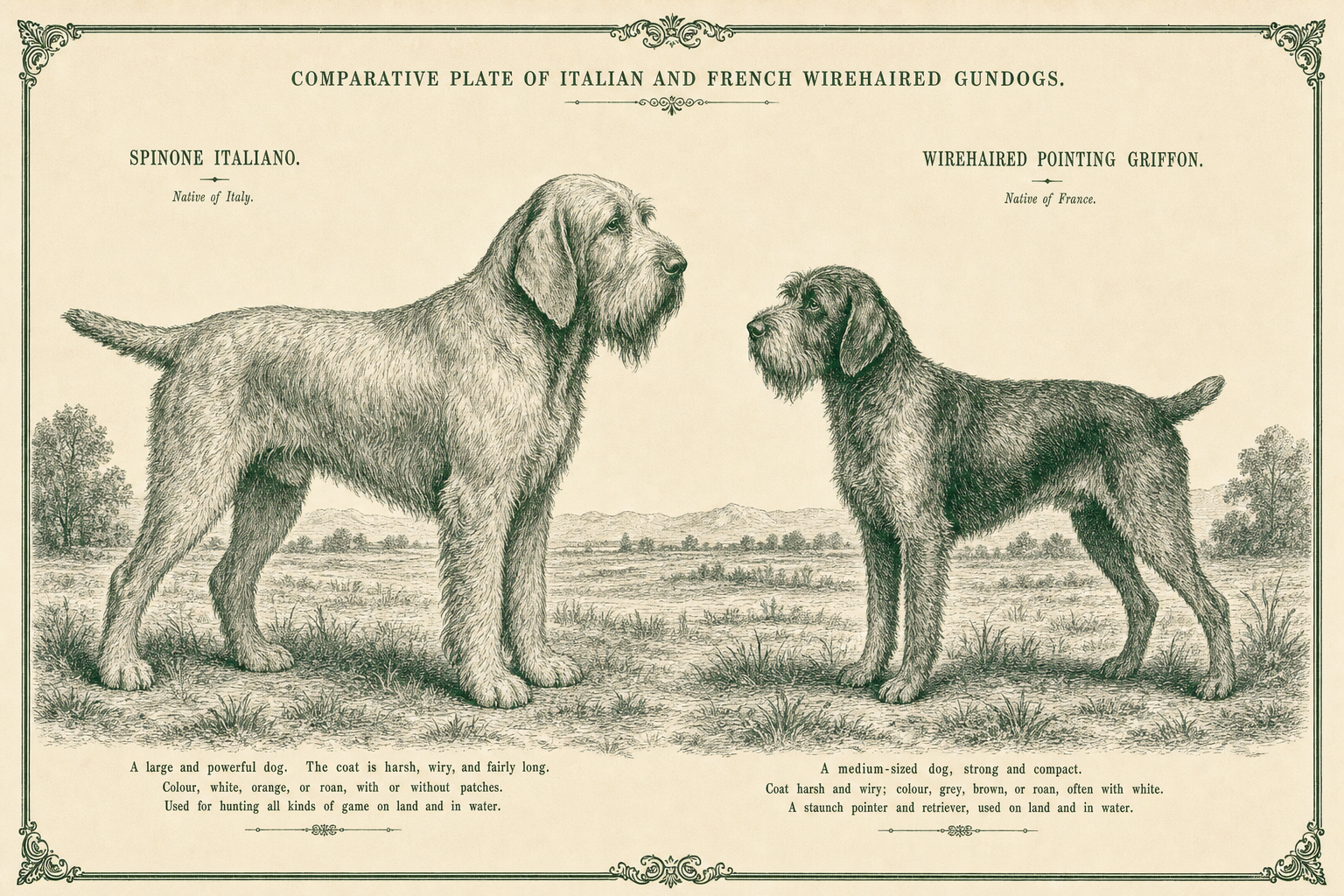
Wirehaired Pointing Griffon vs. Spinone Italiano — two wire-coated continental versatile breeds with different tempos.
Hunting Style: The Trot vs. the Gallop
The Spinone Italiano was built for endurance rather than speed. Its natural gait is a trot — not a gallop — which conserves energy across long all‑day hunts in rugged, mountainous, marshy terrain. According to the Project Upland Spinone profile, the breed was developed to “use their noses and endurance to point, track, and retrieve game on both land and water in rugged, mountainous, marshy, and often thorny terrain.” Its working range is roughly 100 meters — medium, close‑working, and consistent.
The pointing style is genuine and in some bloodlines described as “very solid and often very sudden.” The Spinone’s approach can range from a crouching, feline posture (reminiscent of the WPG) to a more upright point depending on the individual. Retrieving is natural and solid on land and water. The Spinone is also noted as a capable water worker — “excellent water workers” per project upland — though its large size makes a small canoe a tight fit. Blood trailing is a documented capability.
The WPG’s feline, belly‑to‑ground point and smooth gallop make it feel more athletic and immediately reactive by comparison. Both dogs suit the walking hunter who wants close‑to‑medium range coverage, but the Spinone’s trotting economy of motion is genuinely different in feel from the WPG’s more energetic forward drive. For context on how both compare across the full versatile breed spectrum, see our gundog comparison series.
Interactive Tool
Which test or trial should your dog do next?
Answer a few quick questions about your dog’s age, training and your goals. We’ll point you to the right next step — NAVHDA, an AKC hunt test or field trial, a UKC or NSTRA title, or the conformation ring.
The Spinone’s breed standard describes it as “sociable, docile, affectionate, and patient” — and owners consistently confirm this. These are big softies in a rough-and-tumble coat. They get along easily with children, other dogs, and other animals. They’re genuinely mellow at home — one of the lower‑energy continental breeds off the field — which makes them manageable for a slightly less active household.
The AKC Spinone page and the Project Upland profile both note that the Spinone has opinions. The breed was developed to think for itself in complex hunting terrain, and that independence shows up in training. They’re cooperative and willing — “cooperative students who want to please you” — but they won’t be rushed or forced. “Go easy on them — there is no need to use force” is the consistent training guidance. The WPG shares that softness but is typically more handler‑focused and quicker to attune to its owner’s cues.
Both breeds are excellent family dogs. The Spinone is especially patient with children and peaceful with other animals. One difference: the Spinone can become withdrawn if kenneled extensively or deprived of human contact. Like the WPG, it needs family integration — not a life at the end of a chain.
Coat, Grooming & Health
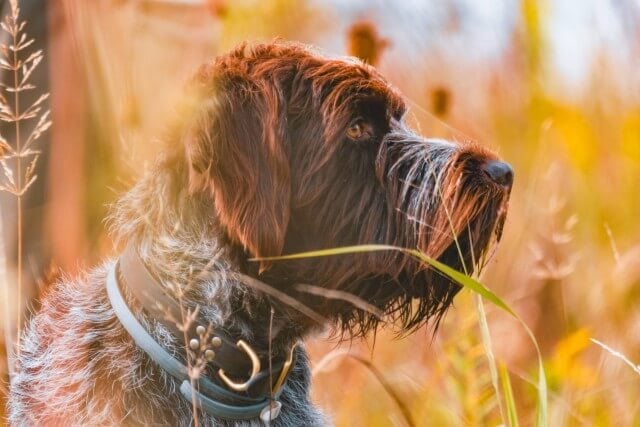
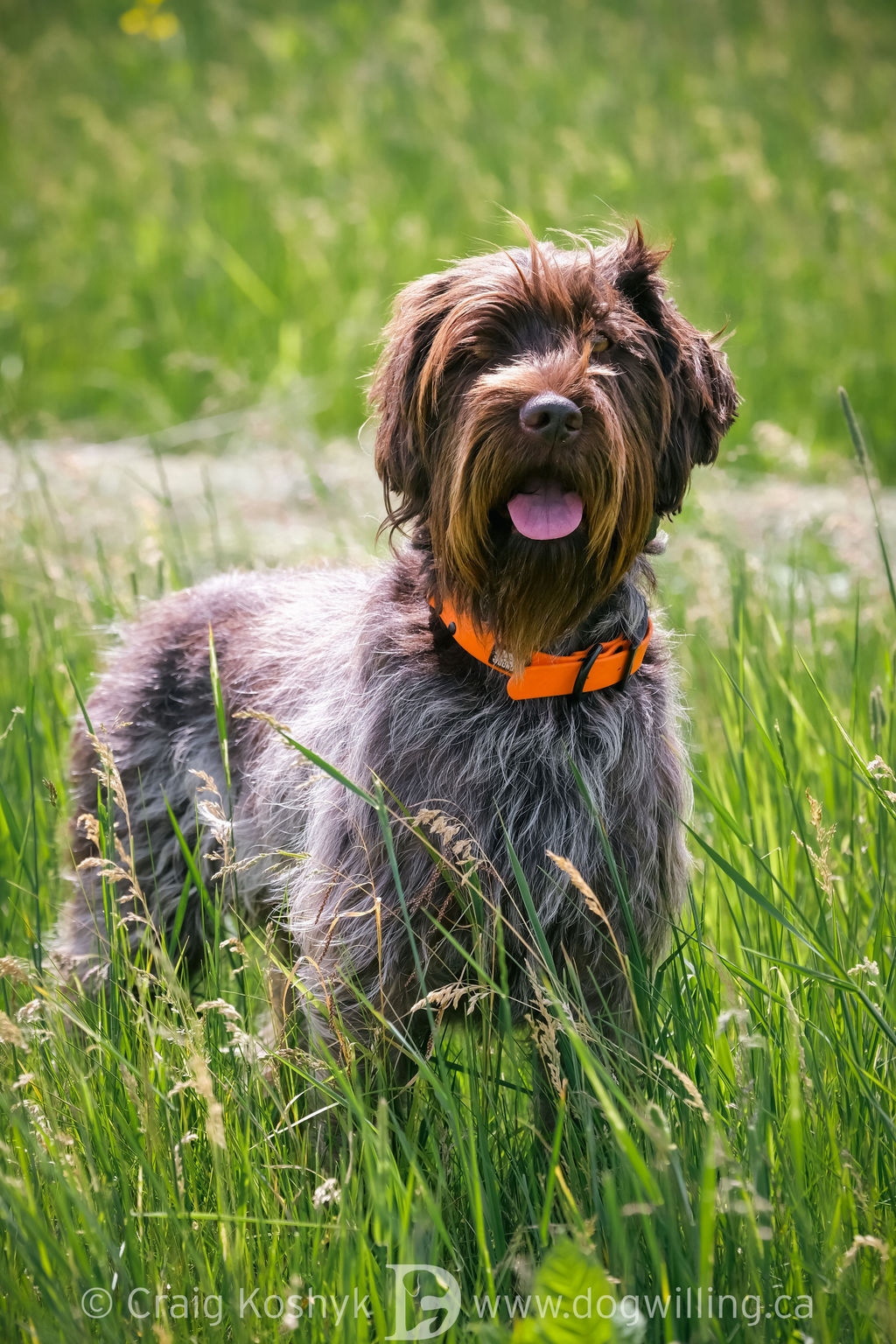
Both breeds are wire‑coated, but with a key structural difference: the Spinone has a harsh, flat wire coat with no undercoat — unusual among wire‑coated continental breeds. The WPG has a harsh topcoat plus a fine, dense undercoat. In practice, the Spinone sheds less (no undercoat to blow) but the beard is a maintenance project all its own. “Beard cement” — a combination of food, water, and debris locked into the facial furnishings — is a daily reality. A dedicated beard rag is essentially standard Spinone equipment, as the PetMD Spinone profile notes directly.
The Spinone does not require hand‑stripping the way a WPG does — regular brushing is sufficient for most owners. That’s a genuine grooming advantage. But the drool situation is real: Spinoni drool and are sloppy drinkers in a way the WPG is not.
Health: the WPG’s recommended tests (OFA hips, elbows, thyroid, annual ACVO eye exam) are detailed at the AWPGA health page. For the Spinone, the most significant breed‑specific concern is cerebellar cortical abiotrophy (CCA) — a neurological condition — for which a DNA test is available. Other concerns include hip dysplasia and elbow dysplasia. A responsible Spinone breeder will test OFA hips, OFA elbows, ACVO eye exam, and the CCA DNA test. Lifespan for the Spinone is generally reported at 10–12 years, somewhat shorter than the WPG’s 12–14 years.
Size is a meaningful difference: males up to approximately 70–85 lb, females 60–75 lb — noticeably heavier than the WPG (males 55–69 lb). If vehicle space, travel logistics, or food costs matter in your planning, the Spinone’s heft is worth considering.
Home Life & Space Needs
The Spinone is the more manageable of the two for an active family that isn’t necessarily hunting four days a week. Its off‑season energy is lower than a GSP or WPG; roughly 60 minutes of daily exercise is the baseline. They can work all day in the field but are not frantic about exercise when they’re home. This makes the Spinone one of the few continental versatile breeds a slightly less intense household could genuinely manage well.
The WPG needs 45–75 minutes of vigorous activity daily and does best in a rural or semi‑rural setting with real seasonal hunting to channel its drive. It’s calmer than a GSP or Weimaraner, but it’s not a low‑energy dog.
Which Dog Fits You?
Choose the Spinone Italiano if you love the idea of a wire‑coated, methodical, all‑day hunting dog with a genuinely gentle soul at home, and you can live with the beard maintenance and the drool. The Spinone’s trotting, endurance‑based hunting style is almost meditative — a deliberate, thoughtful dog that rewards patient partnership. Just verify working lines with any Spinone breeder, as the breed spent decades in North America being developed by show‑oriented breeders rather than hunting ones.
Choose the WPG if you want a wire‑coated versatile dog with a slightly faster, more athletic field presence, a more reliably handler‑focused temperament, and a stronger pointing tradition that includes NAVHDA‑proven credentials. The WPG is also the more amateur‑friendly of the two for first‑time versatile dog owners. The beard still needs cleaning, but at least it’s not dripping.
How this article was made: researched and written with AI, then reviewed, edited, and published by Griffons Out West in Belgrade, Montana.
Breed details here are drawn from Project Upland, PetMD, and AKC; every dog varies by line and breeder, so meet the dogs in person before you decide.