The French System: Cotation, Confirmation & the European Circuit
Now Booking
Spring 2027 Litter
Pepper · Dam
Walker · Sire
✓Health-tested, CHIC-certified parents
✓AKC, UKC, & NAVHDA registered
✓Titled, proven hunting bloodlines
✓Raised in-home for 10 weeks
Limited spots · Screening required
An American hunter looks at his dog and asks a simple question: can it find birds and bring them back? A French breeder looks at the same dog and asks a far harder one: has this dog earned the right to pass its blood forward? That difference in temperament — the patient, almost bureaucratic French insistence on proof before breeding — is the engine that has kept the Griffon a true working breed for a hundred and twenty years. To understand it, you have to understand the strangest, most rigorous grading machine in the dog world: the French cotation.
Fair warning: this is the deep end of the pool. Most American owners will never confirm a dog in France or chase a CACIT across Europe. But every American owner benefits from understanding the system, because it is the template our own NAVHDA testing was modeled on, and it explains why a good Griffon is built the way it is. If you arrived here from the France history article, this is the machinery that story was pointing toward.
In the French system, a dog must be examined, confirmed, and proven afield before it earns the right to breed.
The Players: SCC, FCI, and the Club du Griffon Korthals
Three bodies govern a French Griffon’s life. The Club Français du Griffon Korthals is the breed parent club, organizing the selection events. The Société Centrale Canine (SCC) is France’s national kennel club — the equivalent of the AKC — which maintains the studbook (the LOF) and owns the cotation system. And the FCI sits above it all as the international federation that recognizes the breed standard and sanctions the cross-border circuit (Club du Griffon Korthals).
Step One: Confirmation — the License to Breed
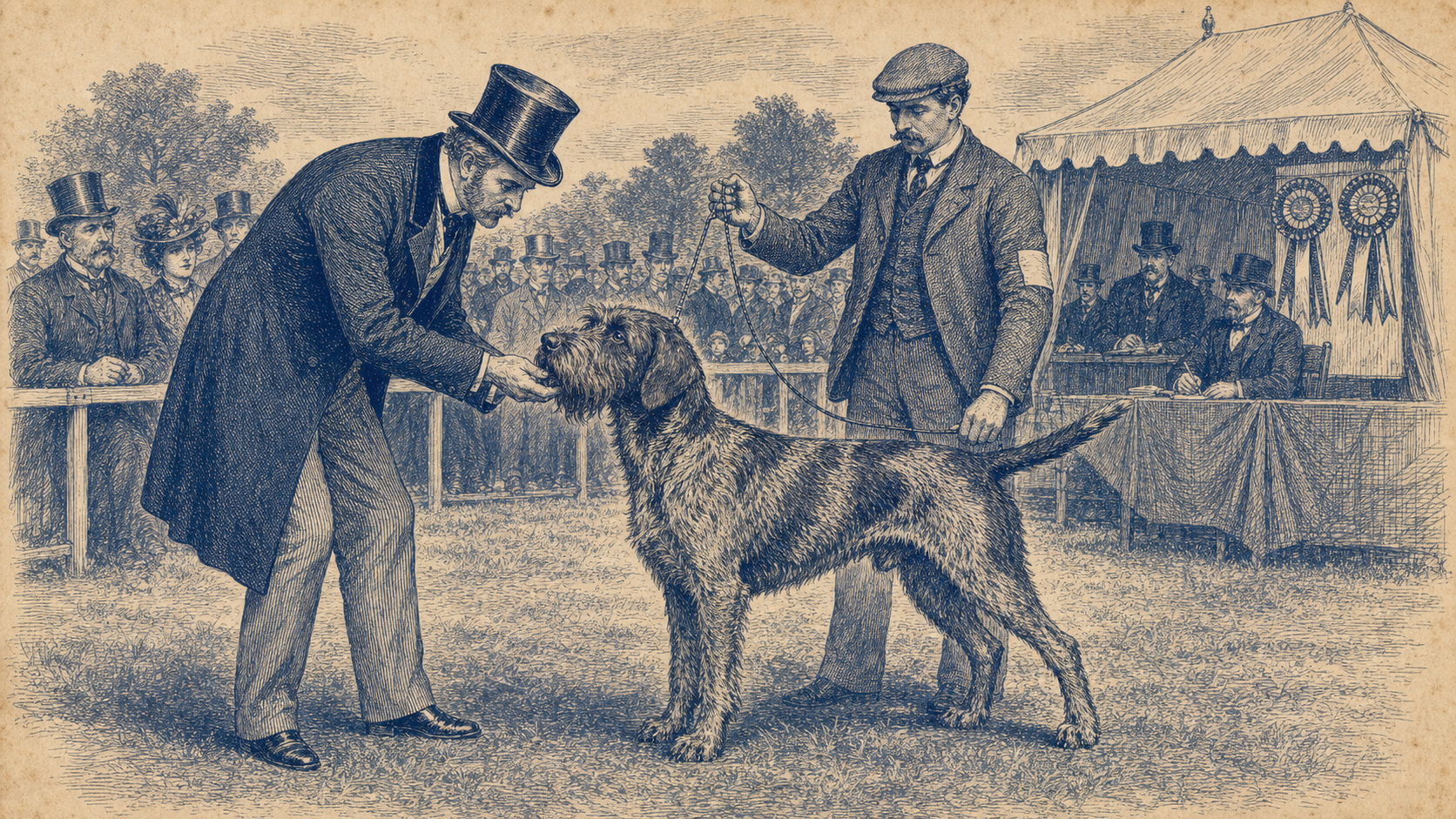
In France a dog is not automatically considered purebred for breeding just because its parents were. It must pass confirmation (conformité au standard) — an examination by a breed expert certifying the adult dog conforms to the standard and carries no disqualifying faults. The Club Français is blunt about what it is: “a breeding authorization that can only be granted after examination by an expert,” designed to catch any transmissible genetic fault or deviation from the standard before the dog reproduces (Club Français Confirmation).
Until a dog is confirmed, it holds only a birth certificate, not a full pedigree définitif. After passing, the paperwork goes to the SCC within a year, the breed club validates it, and the SCC issues the definitive pedigree (FrenchEntrée). For an American owner, this is the relevant door: a US-bred Griffon imported to France for LOF registration must undergo confirmation under the “import” title (Club Français Confirmation).
Step Two: The TAN — Prove the Instinct Is There
The TAN (Test d’Aptitudes Naturelles, Natural Aptitude Test) is the French cousin of the NAVHDA Natural Ability test. Open to dogs aged 6 to 36 months, it evaluates three innate qualities: hunting instinct (the dog’s ardor in searching for game), pointing instinct, and equilibrium (behavioral balance) (Club Français TAN Regulations). Dogs already classified at official field trials are exempt — their ability is considered proven. The TAN is the gateway: it is required for cotation level 2 and underpins every level above it.
Interactive Tool
Which test or trial should your dog do next?
Answer a few quick questions about your dog’s age, training and your goals. We’ll point you to the right next step — NAVHDA, an AKC hunt test or field trial, a UKC or NSTRA title, or the conformation ring.
The Cotation: A Number That Says Everything
Here is the heart of it. The cotation is a grade from 1 to 6 that prints right on a dog’s pedigree and tells any breeder, at a glance, both the dog’s own quality and its value as a breeding animal. Each breed club maintains its own grille de sélection — selection grid — under SCC authority. The current Griffon Korthals grid was published in June 2025 (SCC Griffon Korthals Grille).
Cotation
Label
What it takes (Griffon Korthals, June 2025 grid)
1/6
RECONNU (Recognized)
Dog is confirmed — passed the confirmation exam and holds its pedigree définitif. The baseline all else builds on.
2/6
SÉLECTIONNÉ (Selected)
Confirmed + 1 Excellent at a breed/championship/national show + TAN + hip score A or B + DNA identification.
3/6
RECOMMANDÉ (Recommended)
Confirmed + 1 Excellent at show + hips A/B + a working result: BICP (1st/2nd cat.) or a qualifying spring field-trial placing, with a water-retrieve brevet + DNA.
4/6
ÉLITE B
Higher conformation (CHCS or multiple Excellents under different judges) + a Trialer title or 2 CACT/RCACT + land and water retrieves + hips A/B + DNA parentage compatibility.
5/6
ÉLITE A
A confirmed dog that has produced in the first generation 4 descendants rated 3/6 (males from 2+ bitches; females in 2+ litters), all DNA-verified compatible.
6/6
Top producing level
A RECOMMANDÉ (3/6) dog that has likewise produced 4 descendants rated 3/6 under the same first-generation rules, DNA-verified.
When two dogs are bred, their cotations combine into a litter cotation stamped on the puppies’ birth certificates — a 2×2 pairing yields a litter cotation of 4; an Élite A × Élite A yields 12 (SCC grid via CBMACP). A French buyer can read the breeding quality of a whole litter in a single number before the pups open their eyes. And since 2015, DNA identification is mandatory at cotation 2 and above, with verified parentage required at the top levels — the French simply do not take a pedigree’s word for it.
The Working Certificates: CACT, CACIT, BICP
The cotation’s working requirements are earned at field events with their own alphabet. A CACT (Certificat d’Aptitude au Championnat de Travail) is a national working certificate for a faultless, exceptional field performance. The CACIT is its international equivalent, awarded only at FCI-sanctioned events — and only one per event, with at least six dogs competing (FCI Field Trial Rules). The BICP (International Practical Hunting Certificate), FCI-recognized since 1995, is a practical-hunting test scored by category that feeds the cotation at level 3.
Stack enough of these and a dog can become an International Working Champion (C.I.T.) — requiring two CACITs (or one plus two reserves) under different national organizations and different judges, plus a conformation qualification (FCI Field Trial Rules).
The European Circuit
At the top sit two great annual contests. The Spring European Cup, created in 1985 by the FCI’s Continental Pointer commission, pits national teams against each other on spring game, endowed with CACT and CACIT and scored on a points ladder. The World Championship of Practical Hunting for Pointers, created in 1978, runs each autumn in a different country and demands both fieldwork and a mandatory water retrieve on a live duck in deep water; the dog standing first is crowned World Champion for the year (FCI Field Trial Rules).
An American dog can play, in theory
The system is not sealed off from us. For the FCI’s Spring European Cup and World Championship, dogs registered with the AKC, CKC, or the UK Kennel Club are eligible to compete on national teams — they do not have to be LOF/FCI-registered (FCI Field Trial Rules, Art. VIII & IX). A US-bred Griffon with AKC papers could, in principle, represent a team. An edge case — but a telling one.
Why a Montana Owner Should Care
You may never file a single form in French. But the cotation explains the dog under your hand. NAVHDA was built on this same German-French model of natural-ability-then-utility testing — the TAN maps to NAVHDA’s Natural Ability test, the French autumn trial with retrieve maps to NAVHDA’s Utility test (research synthesis; NAVHDA history). When you understand what the French are measuring and why they refuse to breed a dog that has not proven it, you understand exactly what your NAVHDA test is really for. The proof-before-breeding ethic is the same; only the flag is different.
This is not abstract for us. Our dam, Whiskeytown’s Pepper, is almost entirely French-pedigreed on both sides — only her own dam was born stateside; her sire was imported from France. Read his SCC pedigree and the cotation numbers tell the whole story.
Pepper’s sire, RIRI des Grandes Origines, carries a cotation of 4/6 (ÉLITE B). His parents are a 6/6 dam (GRIFFONNE des Grandes Origines, the top producing tier) and a 3/6 RECOMMANDÉ sire (METEOR des Harmas de Jade). Climb one more generation and the page is stacked with the highest grades the system awards — six dogs rated 6/6 (IZARD, VICTOR, CARLA, O’MALLEY, UMBERTO and SOURIS, all des Grandes Origines and allied kennels), alongside ÉLITE A (5/6) and ÉLITE B (4/6) dogs — nearly every one carrying HD-A hips (the best hip grade) and DNA identification.
In plain terms: the dam side of our program descends from dogs that French breeders themselves grade at the very top of the cotation ladder — confirmed, hip-screened, field-titled, and proven to produce. That European selection rigor is baked into our pups before they are ever born.
How this article was made: researched and written with AI, then reviewed, edited, and published by Daniel Hartzheim of Griffons Out West in Belgrade, Montana.