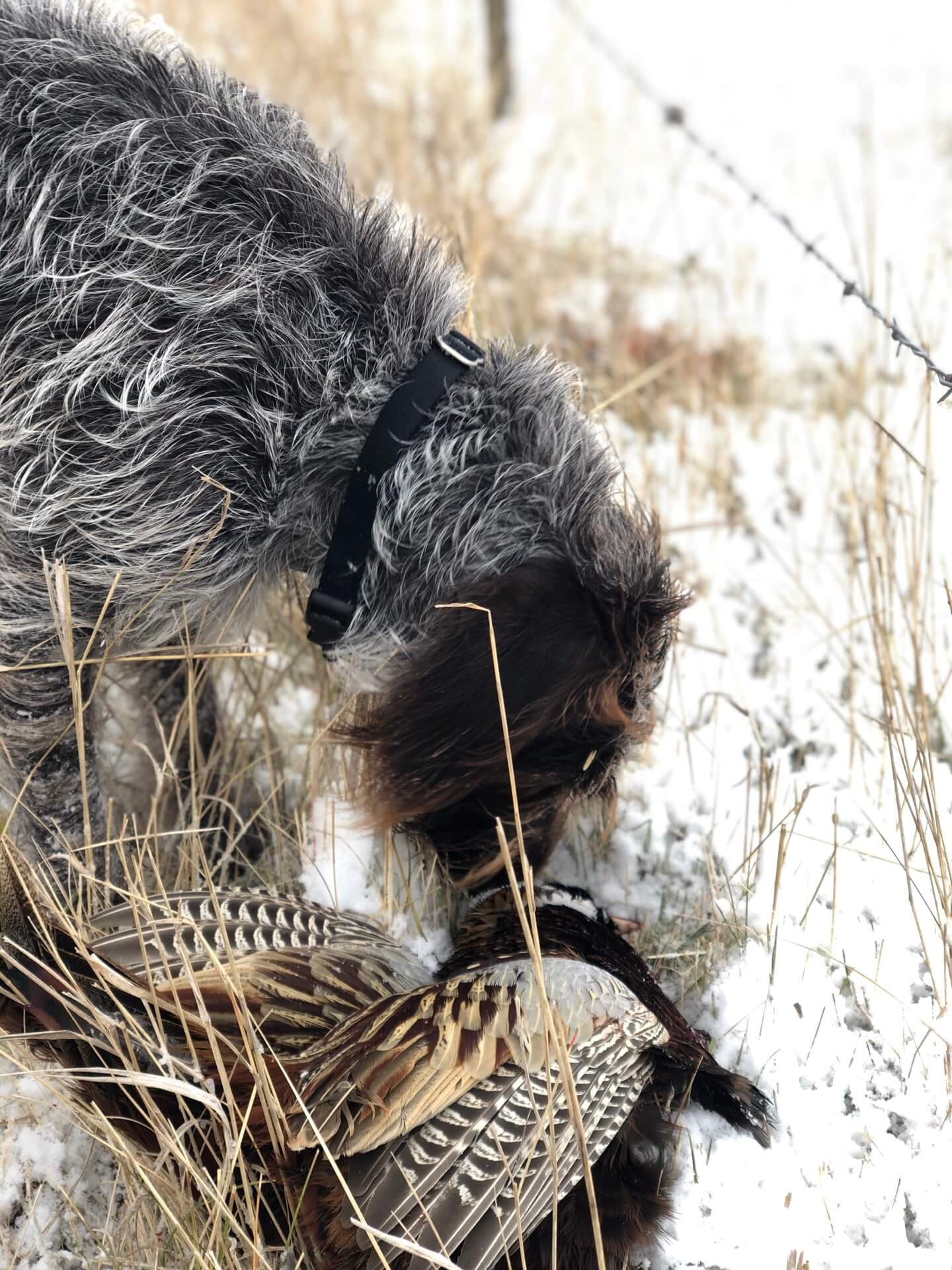
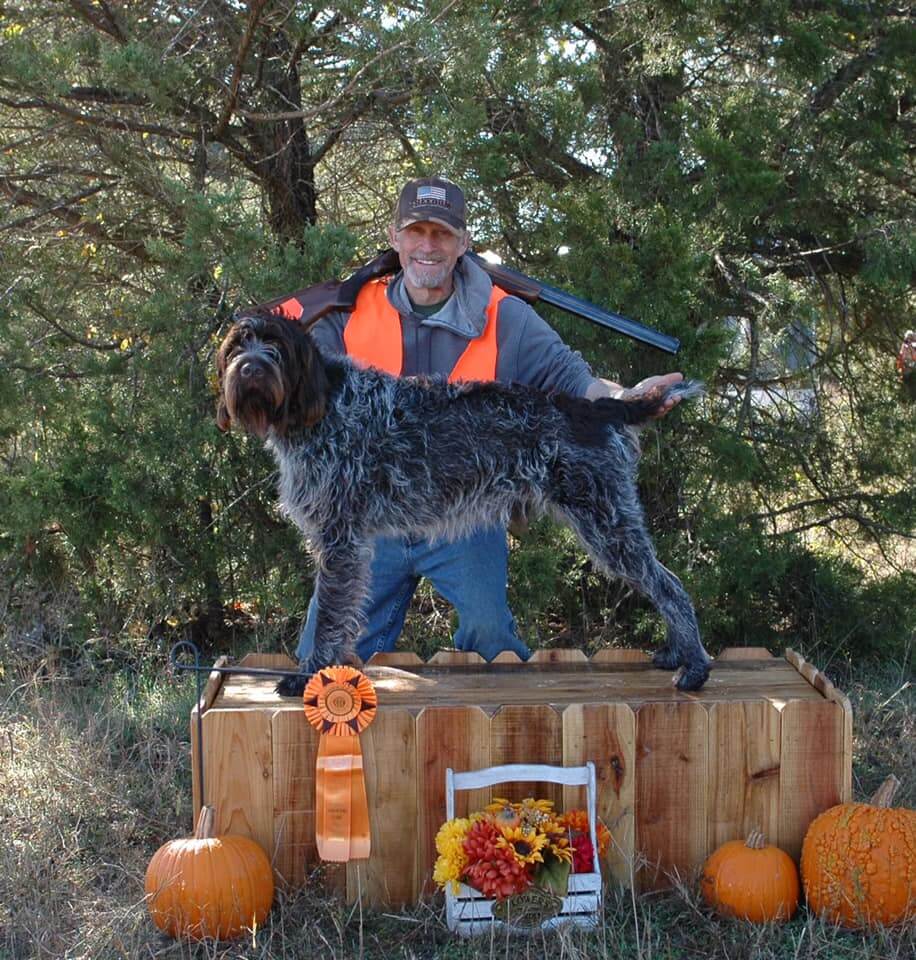
If you own a Wirehaired Pointing Griffon and you mean to find out what he is truly made of, there is one organization built almost as if for him: the North American Versatile Hunting Dog Association, NAVHDA for short. It was founded for exactly the kind of dog the Griffon is — a close-working Continental breed expected to point feathers, track a runner, and swim out for a duck in cold water, all within gun range of a man on foot. No other testing system in this country fits the breed so cleanly. If you read only one piece in this whole library, make it this one.
This is the second post in our Field Tests & Trials series. If you have not yet read the first — the plain difference between a hunt test and a field trial — start there, because everything below assumes you know that NAVHDA tests are pass-against-a-standard, never dog-against-dog.

How NAVHDA Judges a Dog
Every NAVHDA test works the same way at its heart. Your dog runs alone, watched by a panel of three judges who must agree on a single consensus score for each element of the work. Each element earns an achievement score from 0 (failure) to 4 (excellent), and that raw mark is multiplied by a fixed index — a weight factor that says how much that skill matters. Nose, for instance, carries the heaviest index in the system. The weighted scores are summed, and the dog is placed in Prize I, Prize II, Prize III, or No Prize.
Here is the catch that trips up newcomers every single year, so read it twice:
Clearing the total point minimum does not earn you the prize. A dog must also meet a separate minimum achievement score in every individual category. Fall below the category minimum in any one element — one weak water entry, one tracking failure — and you cannot receive that prize, no matter how high the total climbed. The category minimums are the binding constraint, not the sum.
NAVHDA runs a ladder of three main tests — Natural Ability, the Gun Dog Test, and the Utility Test — capped by an annual Invitational that confers the breed’s highest performance title. We will climb it rung by rung.
Rung One: The Natural Ability Test (NA)
The Natural Ability test asks the most important question a breeder can ask: what did this dog inherit? It is run on the young dog, before much training can muddy the picture, and it scores seven heritable traits — the raw material a versatile dog is born with. It is the single most useful test in the system for evaluating breeding stock, which is exactly why we run it on our own dogs.
There is a hard clock on it. To receive a prize, a dog must run the NA at 16 months of age or younger. Dogs from sixteen to twenty-two months may run for evaluation only, with no prize awarded. Miss that window and you have missed it for good — so the NA is the one test you plan your puppy’s first year around.
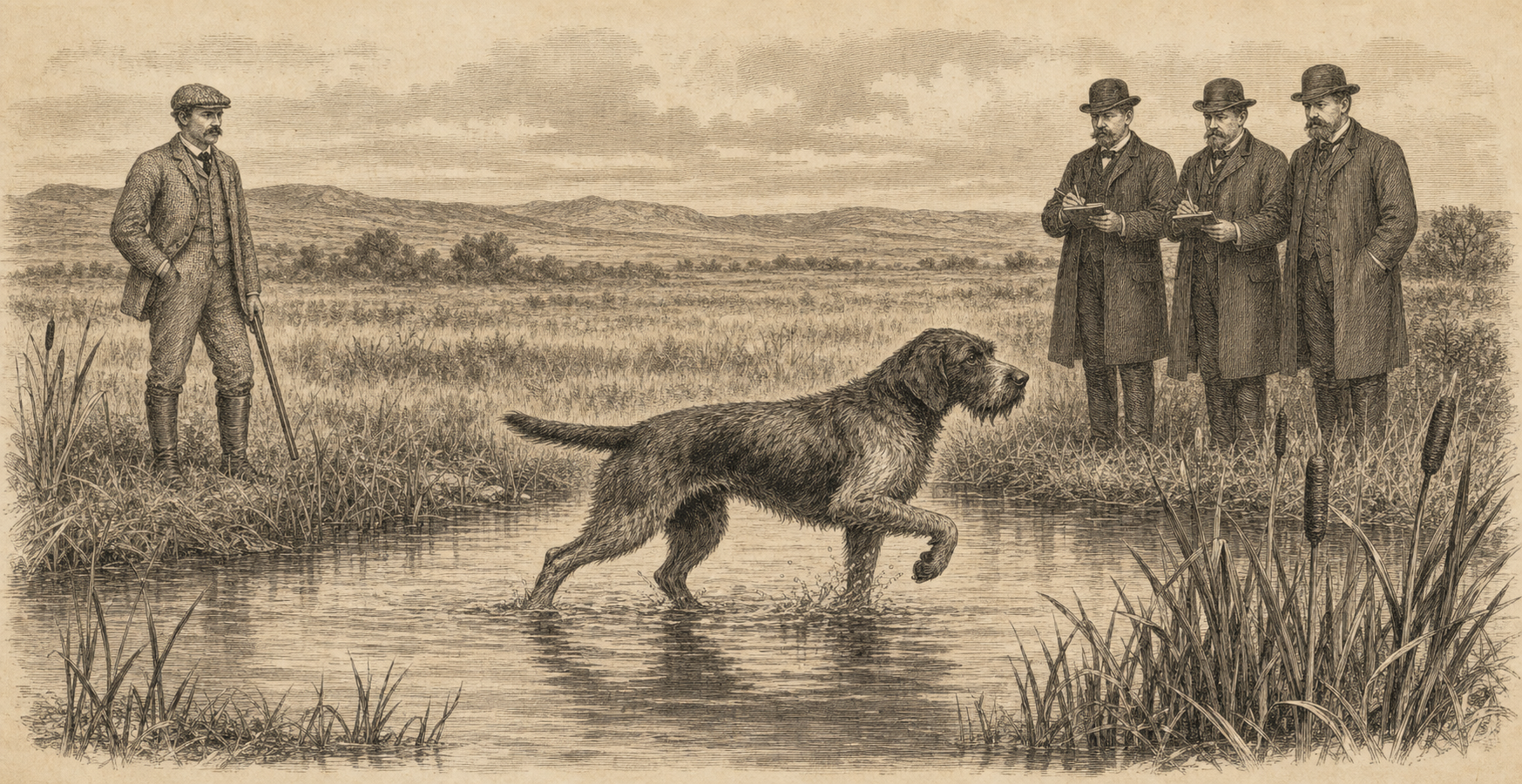
The dog works three phases. A field phase of at least twenty minutes in bird cover, judging use of nose, search, pointing, desire, cooperation, and reaction to the gun. A tracking phase on a flightless running pheasant or chukar. And a water phase, where the dog must show willingness to swim at least twice. Physical attributes — teeth, eyes, coat, temperament — are checked as well. One mercy for young dogs: steadiness is not required or scored in the NA. The pup is expected to point, but he need not hold through the flush.
Natural Ability Scoring (maximum 112 points)
| Element | Index | Max | Prize I min. | Prize II min. | Prize III min. |
|---|---|---|---|---|---|
| Nose | 6 | 24 | 24 (4) | 18 (3) | 18 (3) |
| Search | 5 | 20 | 20 (4) | 15 (3) | 10 (2) |
| Water | 5 | 20 | 15 (3) | 15 (3) | 10 (2) |
| Pointing | 4 | 16 | 12 (3) | 12 (3) | 8 (2) |
| Tracking | 2 | 8 | 6 (3) | 4 (2) | 2 (1) |
| Desire to Work | 4 | 16 | 16 (4) | 12 (3) | 8 (2) |
| Cooperation | 2 | 8 | 6 (3) | 4 (2) | 2 (1) |
| Total | 112 | 99 | 80 | 58 |
Number in parentheses is the minimum per-element achievement score (0–4) required for that prize. Source: NAVHDA Aims, Programs & Test Rules.
So a Prize I dog needs a total of 99 and a perfect 4 in nose, search, and desire — the heritable traits NAVHDA values most. A passing Prize III needs only 58, but it still cannot dip below the floor in any single column.
A dog judged gun shy — one that leaves in fright or quits hunting at the shot — cannot receive any prize, though it may finish the test. (A merely gun-sensitive dog, disturbed but still working, is penalized, not disqualified.) Willful bird mutilation — chewing a bird unfit for the table — also forfeits all prizes, as does running over sixteen months of age. Blinking, deliberately avoiding or abandoning found game, is severely penalized.
Below is NAVHDA International’s own summary of the seven traits and what each phase looks like — the clearest short primer there is, straight from the source.
Rung Two: The Gun Dog Test (GDT)
Where the NA asks what the dog was born with, the Gun Dog Test asks what you have taught him. It is the trained middle of the ladder — a dog roughly halfway between a green pup and a finished hunting companion. Obedience and steadiness are now scored outright, and the work is split into a water group and a field group, with retrieving demanded in both.
You will see this test called both the Gun Dog Test (GDT) and the older Utility Preparatory Test (UPT). The American Wirehaired Pointing Griffon Association uses GDT in its current materials, noting it replaced the UPT; some NAVHDA documents still use the terms interchangeably. The standards and scoring are identical — only the label changed.
There is no age limit here. The water group covers a water search, walking at heel, a steadiness-by-blind stay, and the retrieve of a duck. The field group asks for a search of at least twenty-five minutes, pointing, steadiness on game, the retrieve of a shot bird, and a retrieve by drag. Nose, desire, cooperation, and obedience are judged throughout.
Gun Dog Test Scoring (maximum 184 points)
| Element | Index | Max | Prize I | Prize II | Prize III |
|---|---|---|---|---|---|
| Water Search | 4 | 16 | 16 | 12 | 8 |
| Walking at Heel | 2 | 8 | 6 | 4 | 2 |
| Steadiness by Blind | 2 | 8 | 6 | 4 | 2 |
| Retrieve of a Duck | 3 | 12 | 9 | 6 | 3 |
| Search | 5 | 20 | 15 | 15 | 10 |
| Pointing | 4 | 16 | 16 | 12 | 8 |
| Steadiness on Game | 3 | 12 | 9 | 6 | 3 |
| Retrieve of Shot Bird | 3 | 12 | 9 | 6 | 3 |
| Retrieve by Drag | 3 | 12 | 9 | 6 | 3 |
| Use of Nose | 6 | 24 | 24 | 18 | 18 |
| Desire to Work | 5 | 20 | 20 | 15 | 10 |
| Cooperation | 3 | 12 | 9 | 6 | 3 |
| Obedience | 3 | 12 | 9 | 6 | 6 |
| Total | 184 | 157 | 116 | 79 |
Source: NAVHDA Testing System and the official Test Rules.
Willful bird mutilation forfeits all prizes. Using dead game to coax the dog into the water caps the attainable water score at a "2," which limits the prize level. Failing to retrieve dragged game scores a zero in that element, effectively ending any prize hope.
Rung Three: The Utility Test (UT)
The Utility Test is the summit of the everyday ladder — the measure of a completely finished versatile gun dog, equally at home in upland cover and on the duck marsh. It adds genuine waterfowl work the GDT only hints at: a search for a duck on open water, a stay at a duck blind with the handler out of sight, and stiffer steadiness throughout. Stamina becomes its own judged element. With only five UT dogs allowed per test day — the fewest of any NAVHDA test, owing to its sheer length — a Utility pass is a real day’s work for dog, handler, and judges alike.
Utility Test Scoring (maximum 204 points)
| Element | Index | Max | Prize I | Prize II | Prize III |
|---|---|---|---|---|---|
| Search for a Duck | 4 | 16 | 16 | 12 | 8 |
| Walking at Heel | 2 | 8 | 6 | 4 | 2 |
| Remaining by Blind | 2 | 8 | 6 | 4 | 2 |
| Steadiness by Blind | 2 | 8 | 6 | 4 | 2 |
| Retrieve of a Duck | 3 | 12 | 9 | 6 | 3 |
| Search | 5 | 20 | 15 | 15 | 10 |
| Pointing | 4 | 16 | 16 | 12 | 8 |
| Steadiness on Game | 3 | 12 | 9 | 6 | 6 |
| Retrieve of Shot Bird | 3 | 12 | 9 | 6 | 3 |
| Retrieve of Dragged Game | 3 | 12 | 9 | 6 | 3 |
| Use of Nose | 6 | 24 | 24 | 18 | 18 |
| Desire to Work | 5 | 20 | 20 | 15 | 10 |
| Stamina | 3 | 12 | 9 | 9 | 6 |
| Cooperation | 3 | 12 | 9 | 6 | 3 |
| Obedience | 3 | 12 | 9 | 6 | 6 |
| Total | 204 | 172 | 129 | 90 |
Source: NAVHDA Utility Test and the official Test Rules.
A dog that initiates a fight can be expelled and cannot pass. Leaving the field for more than twenty minutes takes the dog out of judgment for field work. A dog leashed for interfering with its bracemate cannot receive a passing score. Bird mutilation forfeits all prizes, and failing the dragged-game retrieve scores a zero that precludes a prize.
The Summit: The Invitational and the Versatile Champion (VC)
Above the everyday ladder sits the NAVHDA Invitational, held once a year, and it is rare air. To even enter, a dog must have earned Prize I in the Utility Test in the same calendar year, have DNA on file, and be owned by a NAVHDA International member. Unlike every other test, the Invitational is run in braces — two dogs in the field at once — so the panel can judge backing and honoring, the gentlemanly art of one dog respecting another’s point. It is still judged against a standard, not for placement.
| Element | Index | Max | Min. to qualify |
|---|---|---|---|
| Search | 5 | 20 | 15 |
| Pointing | 5 | 20 | 20 |
| Backing | 3 | 12 | 9 |
| Field Steadiness | 3 | 12 | 9 |
| Field Retrieve | 3 | 12 | 9 |
| Heeling | 2 | 8 | 6 |
| Steadiness at Double Mark | 2 | 8 | 6 |
| Double Mark Retrieve | 4 | 16 | 12 |
| Blind Retrieve | 4 | 16 | 12 |
| Honoring at Blind | 2 | 8 | 6 |
| Nose | 6 | 24 | 24 |
| Desire | 5 | 20 | 20 |
| Cooperation | 3 | 12 | 9 |
| Obedience | 3 | 12 | 9 |
| Total | 200 | 166 |
Source: NAVHDA Invitational Test.
A dog that qualifies earns the title Versatile Champion (VC), carried before its name. Earn it once and the dog is retired from future Invitationals — you cannot collect the title twice. It is the highest performance honor a Wirehaired Pointing Griffon can win in this country, and only a small fraction of dogs ever tested reach it.
Natural Ability tells you what the dog was born with. Utility tells you what he and his handler became. The VC tells you they were among the best in North America in a single, unrepeatable year.
Why NAVHDA Is the Griffon’s Home
The whole system was architected for Continental versatile breeds, and the Wirehaired Pointing Griffon is one of the most common dogs in it. The close-working, cooperative, swim-anything foot-hunter that NAVHDA was designed to reward is the Griffon, trait for trait. That is why the American Wirehaired Pointing Griffon Association tracks field achievement largely through NAVHDA results and hands out annual Field Dog of the Year honors to the breed’s top UT and VC dogs.
If you are starting a Griff puppy this year, the path is clear: aim for Natural Ability before sixteen months, build toward the Gun Dog Test as training matures, and let the Utility Test be the long goal that shapes how you train every season in between. From here, the rest of this series walks through the other programs — AKC hunt tests, AKC field trials, the UKC pointing program, and NSTRA — but for a Griffon, NAVHDA is where the trail begins.