Griffon Health Testing: What the AWPGA, UKC & French Clubs Require
Now Booking
Spring 2027 Litter
Pepper · Dam
Walker · Sire
✓Health-tested, CHIC-certified parents
✓AKC, UKC, & NAVHDA registered
✓Titled, proven hunting bloodlines
✓Raised in-home for 10 weeks
Limited spots · Screening required
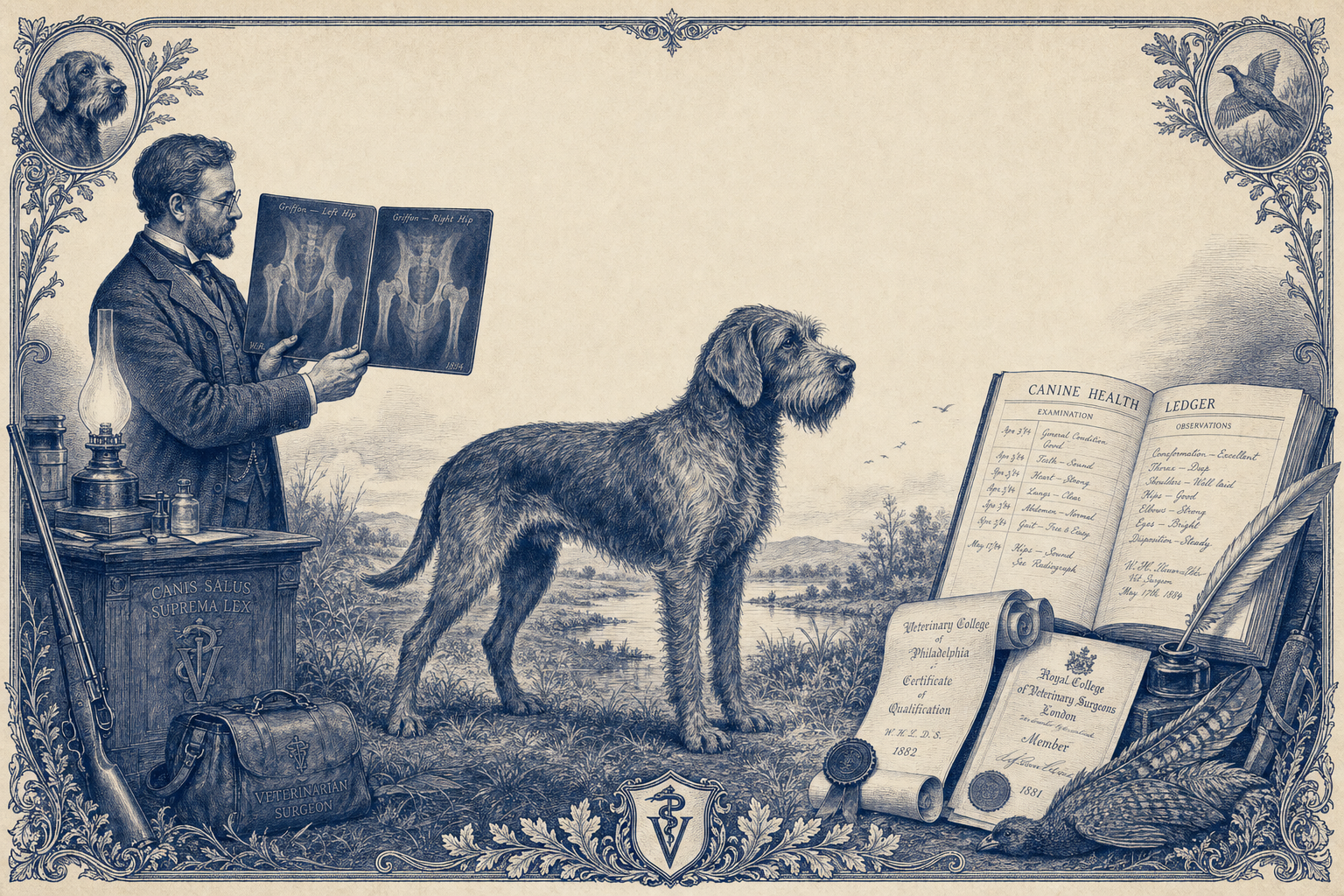
Two Griffons can look identical across a kennel run — same harsh coat, same square head, same soft brown eyes — and one of them carries hips that will fail at five years old while the other does not. You cannot see the difference. The breeder cannot feel it. The only way anyone knows is a set of x‑rays, an eye exam, and a blood draw, read by veterinary specialists and published where you can check them yourself. That is what health testing is: the part of breeding you are not supposed to take on faith.
This article lays out the health tests a Wirehaired Pointing Griffon should have behind it before it is bred — not our house rules, but the published requirements of the people who govern the breed: the AWPGA (the AKC parent club in America), Korthals Griffon United States (the UKC’s breed club), and the French club that holds the breed’s home standard. Then we will show you, plainly, how our own sire and dam meet them — with the actual results, and where to verify each one.
Health testing is the part of breeding you are not meant to take on faith — x‑rays, eye exams, and blood work, read by specialists and published where anyone can check them.
What “health tested” actually means
The phrase gets used loosely. A backyard litter advertised as “vet checked” means a puppy got a once‑over and its shots — useful, but not the same thing. Real health testing means standardized screening for the heritable conditions known in the breed, performed by qualified specialists, scored against a national database, and published so a buyer can look it up. In the United States that database is the Orthopedic Foundation for Animals (OFA), and the public marker that a dog has completed its breed’s recommended panel is a CHIC number — the Canine Health Information Center number.
One honest caveat that responsible breeders will tell you and others hope you never learn: a CHIC number means the tests were done and the results published — not that the dog passed every one. A dog with fair hips and a CHIC number still has a CHIC number. So the number is the starting point, not the finish line. What you actually want to read are the results behind it, which is exactly why we publish ours in full.
The AWPGA panel: what the American parent club requires
The American Wirehaired Pointing Griffon Association is the AKC parent club — the keeper of the standard, and the body that sets the CHIC requirements for the breed in America. To earn a CHIC number, a Griffon must be screened for four things:
Hips — evaluated by OFA, OVC, or PennHIP for hip dysplasia. The Griffon is a fortunate breed here: hip dysplasia has historically been low, but “low” is not “none,” and you screen anyway.
Elbows — OFA or OVC evaluation for elbow dysplasia.
Eyes — an exam by a board‑certified veterinary ophthalmologist (ACVO), after 12 months of age, recorded with OFA.
Thyroid — an OFA autoimmune thyroiditis evaluation, a requirement the AWPGA added effective August 1, 2017.
Beyond the CHIC four, the AWPGA also points breeders to a breed‑specific DNA test for a coat‑color anomaly tied to a tan gene — not a health threat, but a genetic marker conscientious breeders track. The AKC summarizes the same hip, elbow, and ophthalmologist recommendations in its Sporting Group health‑testing requirements.
Interactive Tool
Which test or trial should your dog do next?
Answer a few quick questions about your dog’s age, training and your goals. We’ll point you to the right next step — NAVHDA, an AKC hunt test or field trial, a UKC or NSTRA title, or the conformation ring.
The UKC side: Korthals Griffon United States
The Griffon is registered with the UKC as well, and its UKC breed club — Korthals Griffon United States (KG‑USA) — maintains its own breeding requirements, which line up closely with the AWPGA on the joints and eyes but differ in two interesting ways.
For hips, KG‑USA accepts any one of three roads: an OFA rating of Excellent or Good, a PennHIP distraction index of 0.50 or better, or a French SCC rating of A or B. For elbows and eyes, OFA evaluation with a Normal rating is required for the parents of any litter where both parents were born on or after December 16, 2022 (and recommended for older dogs). Where it parts ways with the AWPGA is thyroid: KG‑USA does not currently require it, on the practical reasoning that the available thyroid certifications often do not finalize until a dog is around eight years old — long after most breeding decisions are made. It is a defensible difference of opinion between two serious clubs, and worth understanding rather than glossing over.
KG‑USA also folds field ability into its breeding standard — requiring earned field titles on the parents — which is a reminder that in this breed, “health” and “function” were never meant to be separated. We walk the full UKC pointing program, and every title in it, in our UKC Pointing Dog Program guide.
The French view: hips, confirmation, and cotation
Because the Griffon’s recognized country of origin is France, the French system deserves a seat at this table even for American buyers. The French club screens hips on the SCC’s A–E scale (A and B being the breeding grades) and folds health into a larger gatekeeping process the French call Confirmation and cotation — a six‑tier grading system that decides whether a dog has earned the right to pass its blood forward at all. It is a stricter, more centralized philosophy than anything in the American registries, and it is the reason European Griffon lines tend to be so consistent. We devote a full deep‑dive to it in The French System: Cotation, Confirmation & the European Circuit.
Put the three systems side by side and the agreement is striking: everyone screens hips, elbows, and eyes. They differ at the edges — thyroid, the DNA color test, the French confirmation grades — but the core of a sound Griffon is not in dispute.
How our dogs meet the bar
This is the part that should matter most to you, because it is the part you can verify. Both parents of our litters carry full, published clearances — not a vague “health guarantee,” but specialist‑read results you can look up by name.
Pepper carries the complete AWPGA CHIC panel, published under CHIC #220031:
Hips: Good (OFA)
Elbows: Normal (OFA)
Eyes: Normal (ACVO / OFA)
Thyroid: Normal (OFA)
That is all four AWPGA CHIC requirements — and her hip and elbow ratings also satisfy the KG‑USA standard on the UKC side. You do not have to take our word for any of it: her full results, the certificate images, and a direct OFA/CHIC verification link live on her page, in the health‑clearances section. We put them in public on purpose.
Walker is screened on the same joints, with results that comfortably clear the breeding bar:
Hips: PennHIP 0.21 right, 0.22 left — well inside the 0.50 threshold KG‑USA accepts, and an excellent distraction index by any standard.
Elbows: Normal (OFA)
Thyroid: Normal (OFA)
His PennHIP numbers are the kind that make a structure‑minded buyer relax — the lower the index, the tighter the hip. The full record sits on his page alongside his field and conformation titles.
Pair the two and you get exactly what the clubs are trying to protect: a litter out of two specialist‑cleared parents, with hips, elbows, eyes, and thyroid accounted for on the dam’s side and tight, low‑index hips on the sire’s. That is not a marketing line. It is a set of numbers you can check before you ever send a deposit.
What to ask any breeder — including us
If you take one thing from this article, let it be a short checklist. When you talk to any Griffon breeder, ask:
“Do both parents have OFA results I can look up?” A real answer is a CHIC number or an OFA name you can search. A vague answer is a red flag.
“What were the actual hip and elbow ratings?” — not just “they’re cleared,” but Good, Excellent, the PennHIP index, the elbow grade.
“Were the eyes examined by an ACVO ophthalmologist?”
“Can I see the certificates?” If a breeder hesitates to show you paper, you have your answer.
Good breeders welcome these questions, because answering them is the whole point of having done the work. If you would like to see where the rest of this fits — the registries, the clubs, and how a Griffon earns its place — start with our Griffon Owner’s Guide to History, Registries & Clubs, or read about the breed itself.
How this article was made: researched and written with AI, then reviewed, edited, and published by Daniel Hartzheim of Griffons Out West in Belgrade, Montana.