The United Kennel Club’s pointing dog program is, by the UKC’s own description, a deliberate blend of the two worlds we have been mapping in this series: “a program that combines the best of both the field trial and the hunt test formats.” Dogs earn placements like a field trial, but they can also earn passes against a standard like a hunt test — and, as the UKC puts it, “dogs do not have to beat other dogs to earn credit towards a Champion title.” It is a walking program built for companion gun dogs, which makes it a comfortable fit for a Wirehaired Pointing Griffon. This is the fifth post in our Field Tests & Trials series.
The UKC runs a separate Hunting Retriever Club (HRC) program with its own titles (SHR, HR, HRCH, GRHRCH) built around retrievers. That is not the program for a pointing breed. A Griffon owner wants the UKC Pointing Dog Program described here. The UKC also recognizes NSTRA championship titles on UKC pedigrees, the result of a 2012 affiliate agreement.
The UKC Ladder
The program runs from two simple natural-ability tests — pass/fail, not competitive — up through competitive classes that build to championship titles. Below is the full ladder; we will climb it rung by rung.
| Rung | Type | Age | Core demand |
|---|---|---|---|
| TAN — Natural Ability Test | Pass/fail test | 6 mo. to under 3 yr. | Hunt, point a bird 3+ seconds, not gun-shy |
| WRT — Water Retrieve Test | Pass/fail test | 6 mo., no upper limit | Enter water, retrieve a bird to shore, not gun-shy |
| Gun Class → GUN title | Competitive class | 6 mo.+ (untitled in Open) | Find, point, retrieve; steady to wing only |
| Open Class → TR, CHF, GRCHF | Competitive class | 1 yr.+ | Steady to wing, shot & fall; retrieve to hand |
Source: UKC Upland Hunting Programs and the official UKC Pointing Dog Rulebook.
TAN — The Natural Ability Test
The TAN (Test of Natural Ability) is the entry point and a wonderfully low-pressure one. It is open to UKC-registered pointing dogs that have not yet reached their third birthday, and it asks only three things: the dog must hunt the field independently, find and point a bird for at least three seconds, and show a normal reaction to gunfire (no gun shyness). After the point, the young dog may break, chase, and behave like any green pup — steadiness is not evaluated at all. Pass, and the UKC issues a TAN certificate. The TAN is a prerequisite toward the Hunt title.
WRT — The Water Retrieve Test
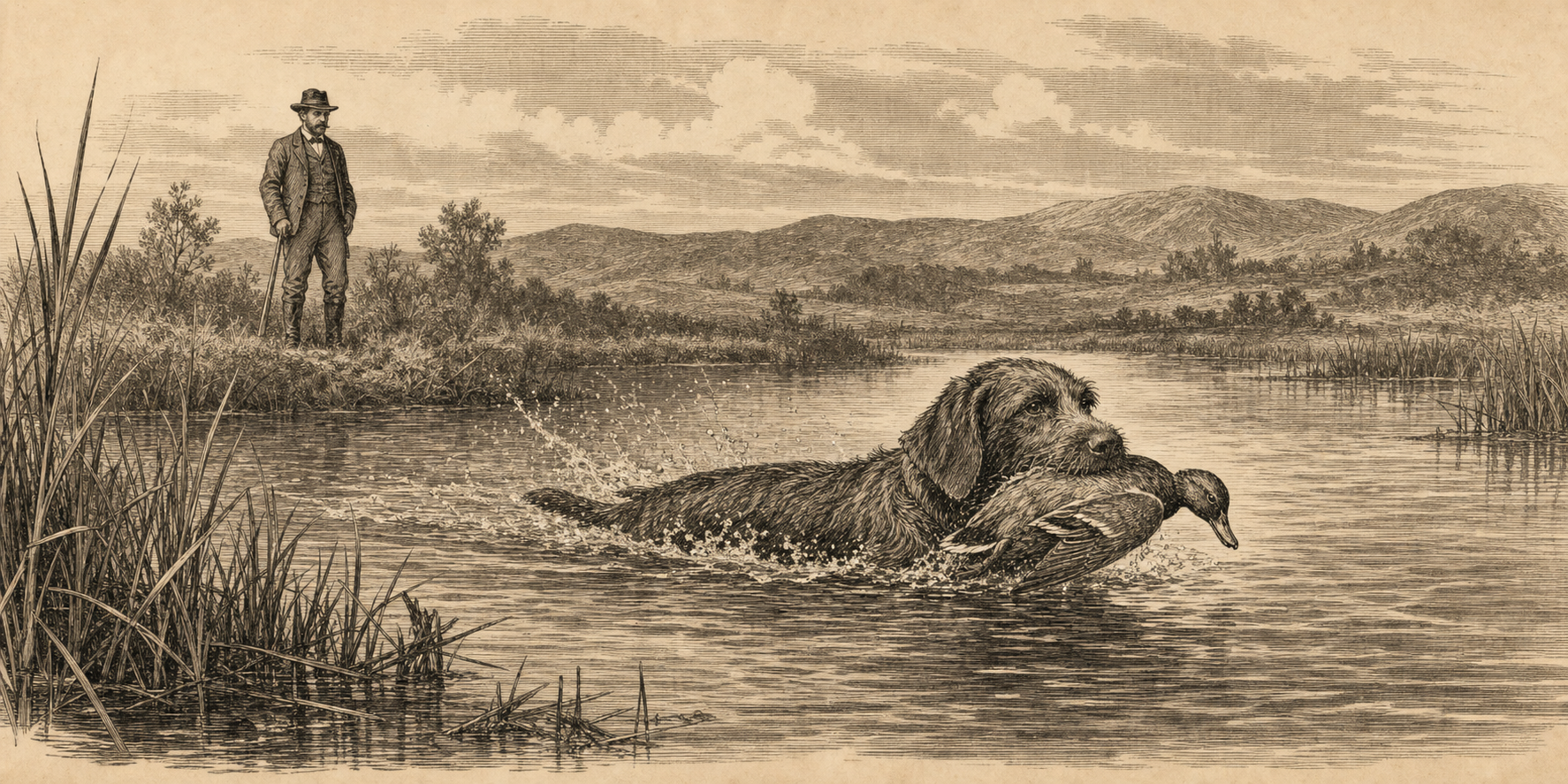
The WRT measures natural willingness in the water, not a polished retrieve. A dead bird is thrown into water with a shot fired, and the dog is judged on three things: willing water entry and handling, the natural retrieve (the dog must return with the bird and reach dry land with all four paws — delivery to hand is not required), and reaction to gunfire. There is no upper age limit. A Griffon, bred to swim for waterfowl, generally takes to this readily. Earn both TAN and WRT and your dog is well set up for the Gun Class.
For a thorough, club-led walkthrough of every UKC pointing event — the TAN, the Gun Class, and the Open Class — this handler’s clinic from CEB-US (the club that ran the very first UKC pointing trial) is the most complete primer available.
Gun Class and the GUN Title
The Gun Class is the working-hunter tier — for beginning and intermediate dogs. It is a competitive class in form, but titles are earned by accumulating pass-or-better classifications rather than by outright beating other dogs. The dog must find and point birds and retrieve, but it need only be steady to wing — it may break after the flush. In liberated-bird trials the dog must bring the shot bird to within about fifteen feet of the handler. The class may be run solo or in braces; in braces, backing and honoring are evaluated.
A dog earns the UKC GUN title with three pass-or-better classifications, including at least one Certificate of Achievement to Gun Title (CAG) — or two Reserve CAG (RCAG) classifications. Once a dog earns a title in the Open Class, it can no longer enter the Gun Class.
Open Class and the Champion Titles
The Open Class is elite competition for finished dogs — at least a year old, fully steady to wing, shot, and fall, and unable to move for the retrieve until the judge releases them. The retrieve must be clean and to hand. Run solo or in braces; in braces, spontaneous backing is required. Performances earn classifications: PASS (Very Good), EXC (Excellent), and the placement awards CAC (Certificate of Achievement to Championship) and RCAC (Reserve CAC).
| Title | Requirement |
|---|---|
| Trialer (TR) | An intermediate title for 1–2 CAC-level wins (or RCAC combinations) in the Open Class, on the road to CHF |
| Champion of the Field (CHF) | Three CAC classifications in the Open Class, from multiple judges. Variants: CHF (mixed), CHF-W (wild bird), CHF-L (liberated bird) |
| Grand Champion of the Field (GRCHF) | Five CAC classifications in the Open Class — the highest UKC pointing dog title |
Source: UKC Pointing Dog Rulebook.
The TAN asks only whether the spark is there. The Grand Champion of the Field title says the dog mastered the whole craft — and proved it five times, under more than one judge.
Why the UKC Program Fits a Griffon
The walking format, the emphasis on close-working gun dog style, and the gentle on-ramp of the TAN make the UKC pointing program a sensible complement to NAVHDA for Griffon owners. Its hybrid system — passes against a standard and placements — means a dog can title cooperatively without being purely ranked against its peers. For an owner who wants AKC, UKC, and NAVHDA achievement on one pedigree, this is one of the most accessible pieces of the puzzle. From here the series continues with NSTRA and the bench side, AKC conformation.