The Brittany might be the most underestimated bird dog in North America. Compact, biddable, energetic, and capable — the French describe it as “maximum qualities in a minimal size.” If you’re choosing between a Brittany and a Wirehaired Pointing Griffon, you’re comparing two genuinely versatile pointing dogs with different personalities, different coat maintenance, and a meaningful size gap. Neither is the wrong answer — they suit different hunters.
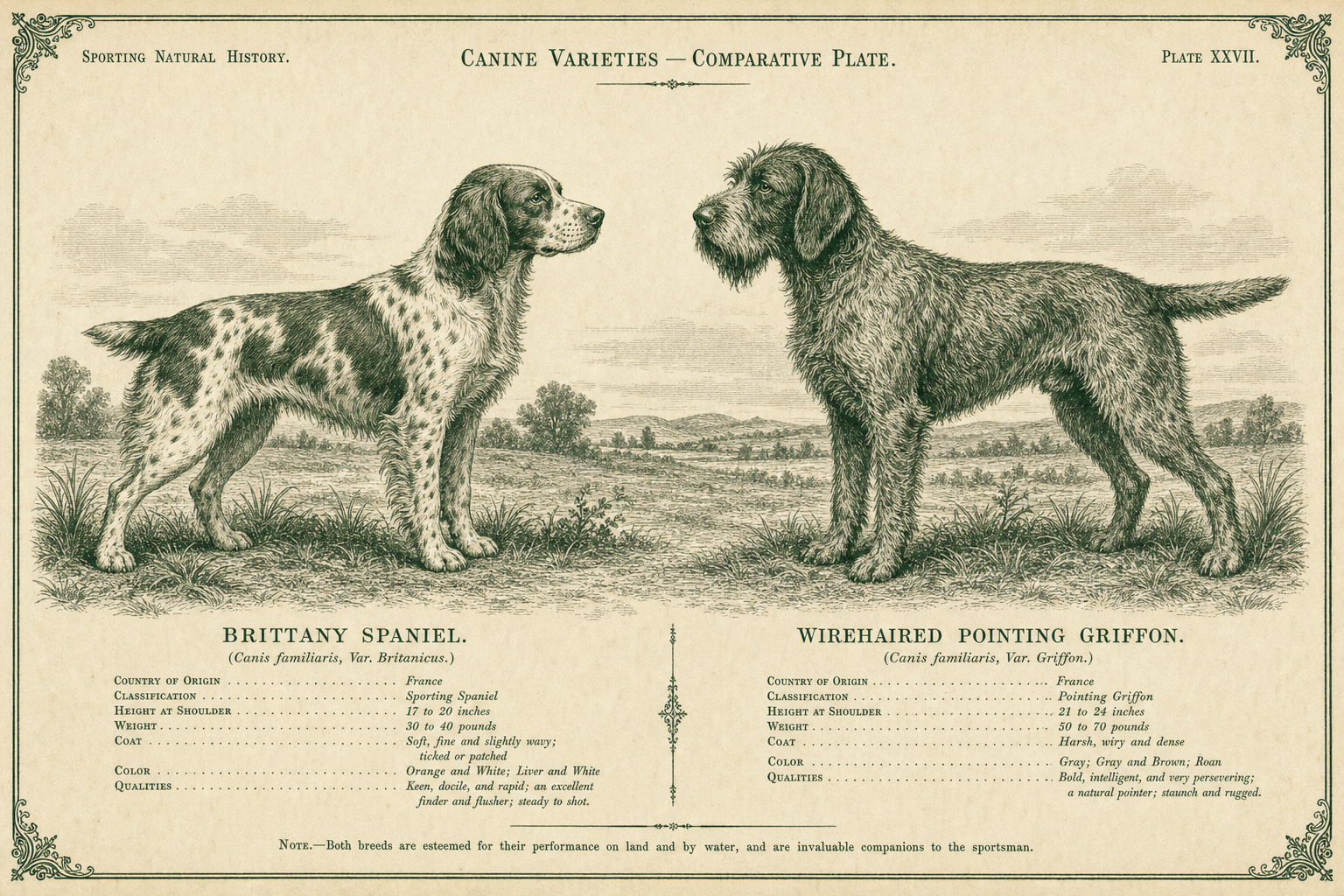
The Brittany and the WPG: both continental pointers, different sizes and coats.
The Brittany is one of the most popular pointing breeds in the world: approximately 15,000 pups whelped annually, including 5,000 in France alone, according to Project Upland’s Brittany profile. That’s an enormous gene pool with proven hunting lines on both sides of the Atlantic. The WPG, by contrast, is a smaller community — but a growing one, with registration numbers in NAVHDA climbing 63% over ten years. Both breeds take NAVHDA seriously, and both have the heritage to back it up.
Hunting Style: The Upland Specialist
The Brittany was developed in France as a close‑cover grouse and woodcock dog, and that heritage still shows in traditional hunting lines: a medium‑range dog that works within gun range, points reliably, and is easy to manage on foot. In North America, field‑trial lines have pushed some Brittanys to run very wide — nearly as wide as an English Setter field dog — so a buyer specifically needs to seek hunting or cover dog lines rather than field‑trial breeding.
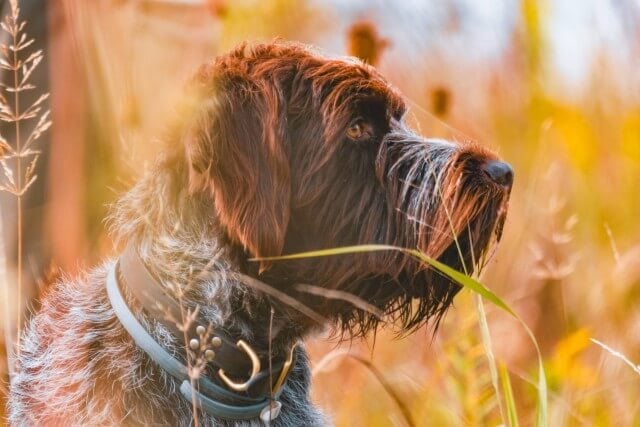
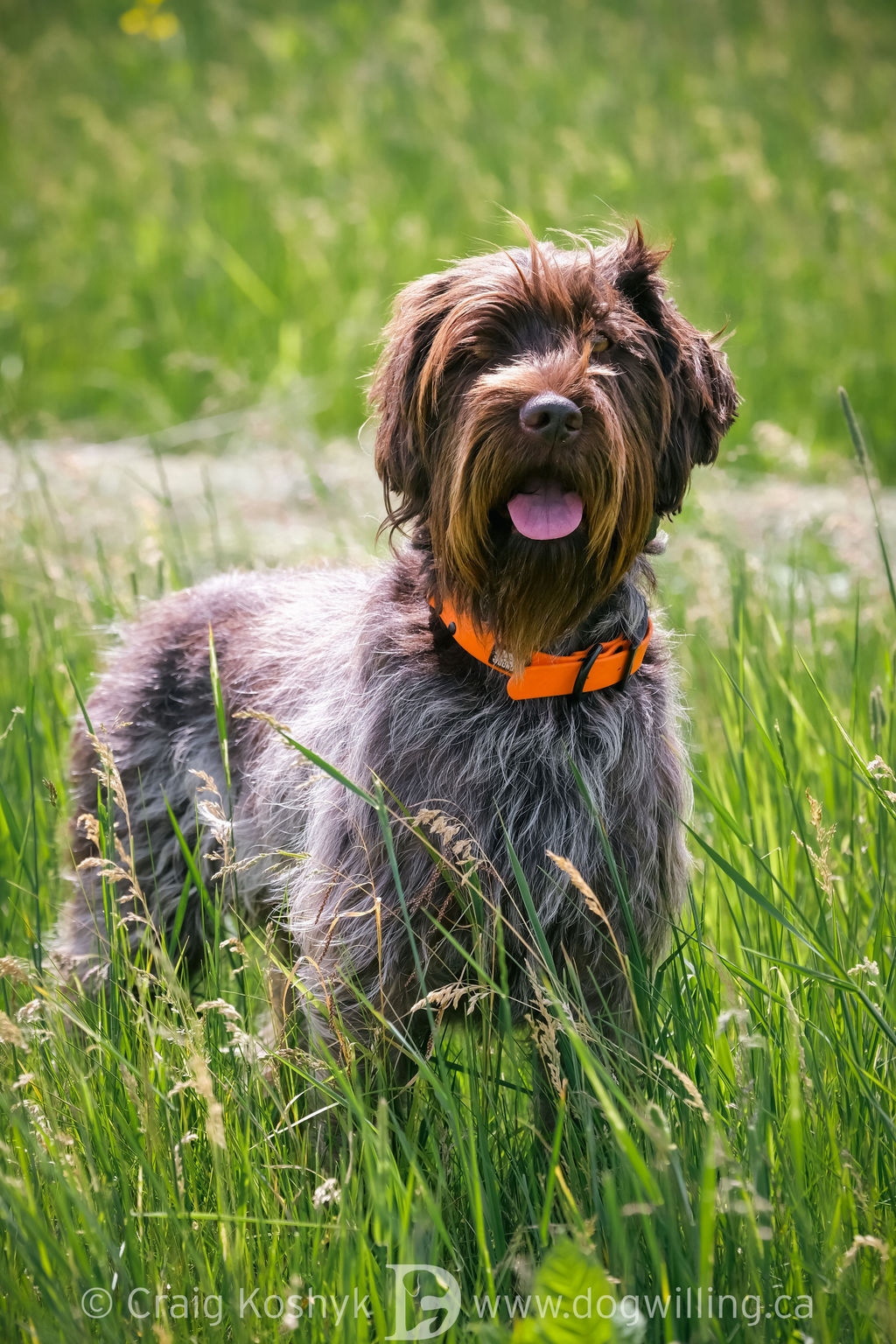
The WPG also hunts at medium range, but its all‑terrain emphasis is broader than a Brittany’s traditional role. The WPG was built for field, forest, brush, and wetlands — it tracks, blood‑trails, and retrieves from cold water with its protective harsh coat. The Brittany can retrieve and will work water, but the breed was not developed as a water dog, and its medium‑length flat coat offers limited cold‑water protection. Early‑season duck retrieves are fine; late‑season icy‑water work is not the Brittany’s best use.
If your hunting is primarily upland — pheasant, grouse, woodcock, quail — the Brittany does everything you need in a package that’s easier to transport, easier to kennel, and easier on the truck seat. If you hunt across multiple seasons and game types including waterfowl, the WPG’s versatility is a real advantage.
Interactive Tool
Which test or trial should your dog do next?
Answer a few quick questions about your dog’s age, training and your goals. We’ll point you to the right next step — NAVHDA, an AKC hunt test or field trial, a UKC or NSTRA title, or the conformation ring.
Size: The Practical Difference
This matters more than people realize. Brittany males run 18–20.5 inches and approximately 30–45 lb — among the smallest pointing breeds. WPG males run 23–26 inches and 55–69 lb. That’s a 20+ lb difference in a typical pairing. The Brittany fits in a smaller kennel, needs less food, takes up less truck space, and is generally easier to handle physically for a smaller hunter or for hunting with children. The compact size is not a weakness — the AKC notes they’re one of the most capable small versatile dogs in the world for their weight class.
Temperament and Trainability
The Brittany is one of the most recommended pointing breeds for first‑time owners, full stop. Training is described as straightforward — “best to rely on their natural talents and their desire to hunt.” The Brittany is on the soft side temperamentally; harsh corrections can cause them to sulk. Consistent, positive training that builds on natural ability is the right approach.
The WPG lands in the same temperamental territory. Both are soft dogs that respond to patience over force. Both are biddable and handler‑oriented. The WPG’s amateur‑friendliness is perhaps its most cited virtue — the Brittany’s is equally real. Either one is a good choice for a hunter who isn’t a professional dog trainer.
Energy levels differ slightly: the Brittany’s 45–60 minutes daily minimum is manageable for an active family even without daily field work. The WPG’s 45–75 minute minimum is comparable, but the larger dog at full drive covers more country and exerts more physical force. Both are medium‑high energy — not frantic like a GSP or Weimaraner, but not couch dogs.
Coat, Grooming, and Health
The Brittany’s medium‑length flat coat with feathering on ears and legs sheds moderately with the seasons and requires regular brushing to prevent matting of the feathering. It’s not a high‑maintenance coat, but it’s more work than a short‑coated breed. No stripping needed. The WPG’s wire coat sheds minimally overall but requires hand‑stripping 1–2 times per year to maintain its harsh, functional texture. Clipping permanently softens a WPG’s coat. Neither coat is difficult; they’re just different kinds of maintenance.
The Brittany is generally a healthy, long‑lived breed — 12–14 years. Seizure disorders (epilepsy) and patellar luxation are the most noted breed‑specific concerns. Recommended health tests include OFA hips, PRA/eyes, and cardiac. Screening for seizure history in the pedigree is important. The WPG’s health program through the AWPGA covers OFA hips, elbows, thyroid, and annual ACVO eye exams. Both breeds carry hip dysplasia risk.
Home Life and Family Fit
The Brittany is an excellent house dog. Its compact size makes it genuinely more adaptable to varied living situations than a larger pointing breed — marginally apartment‑viable if given vigorous daily exercise, practical in smaller homes and vehicles. It’s affectionate and loving, good with children and other dogs, and has moderate Velcro‑ness rather than the extreme clinginess of a Vizsla or Weimaraner.
The WPG is the better fit for a larger home or rural property where the dog has room to express its energy, and for hunters who want a single dog that does everything including cold‑water waterfowl work. It’s equally good with families and children — just bigger and more coat to manage.
Which Dog Fits You?
Choose the Brittany if you want a compact, biddable, lower‑maintenance versatile pointing dog for upland hunting, your family includes small children or apartment‑adjacent living, and you specifically want close‑cover hunting lines (not field‑trial lines). The Brittany is a fantastic dog — arguably the best starter versatile dog available.
Choose the WPG if size is not a constraint and you want broader seasonal capability, cold‑water performance, and the distinctive wire‑coat package. The WPG is larger, lower‑shedding in a different way (wire vs feathered), and built for harsher conditions.