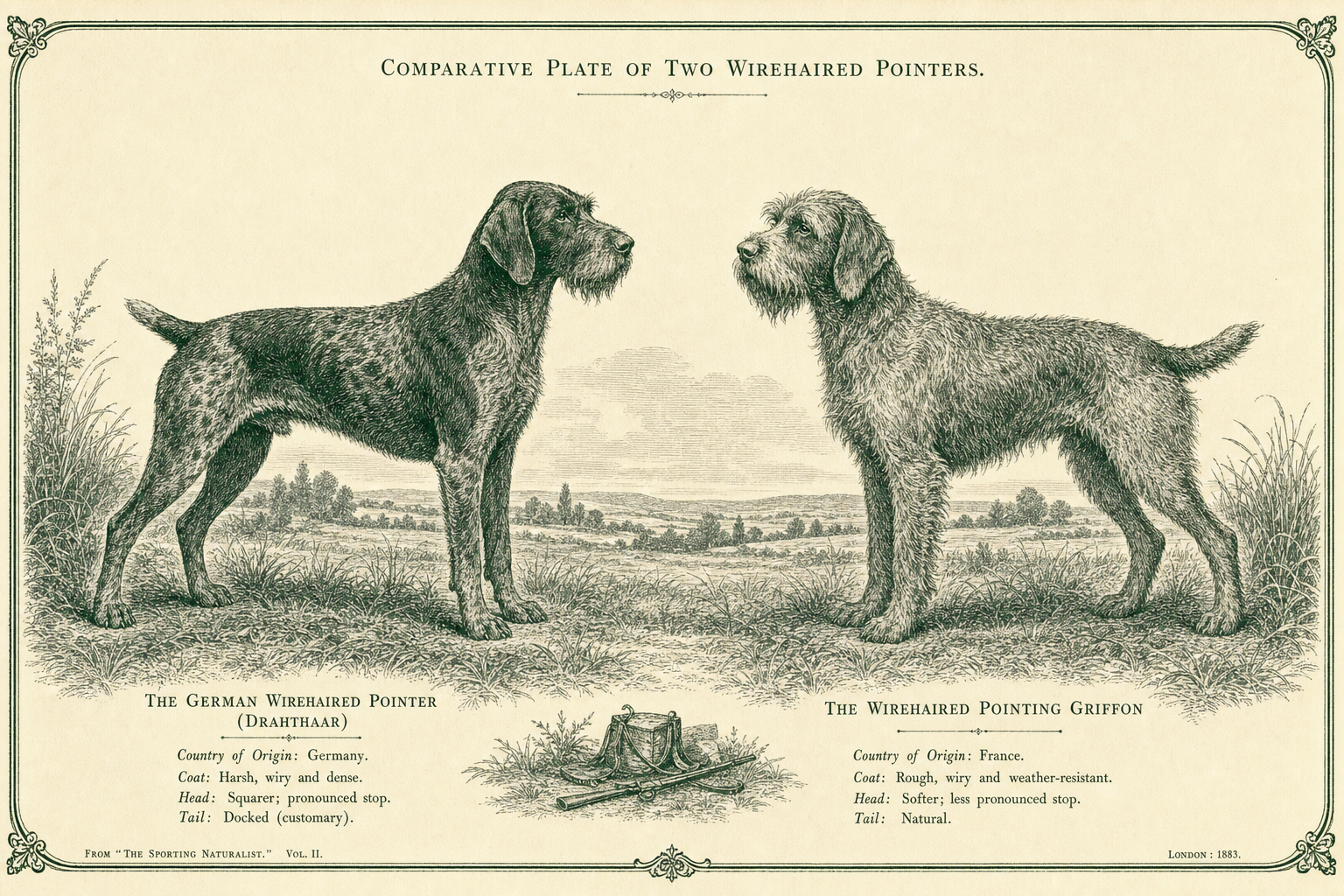
Of all the breeds people confuse with a Wirehaired Pointing Griffon, the German Wirehaired Pointer — and its closely related German cousin, the Deutsch‑Drahthaar — tops the list. Both have wiry coats, beards, eyebrows, and a continental hunting pedigree. Hunters see one at a hunt test and ask, “Is that a Griffon?” A lot. But spend time with both breeds and the differences become clear and meaningful. This is worth getting right before you pick a puppy.
GWP and WPG: similar coats, very different dogs underneath.
The GWP and its German‑registry counterpart the DD (Deutsch‑Drahthaar) are the 5th most popular bird dog breed in North America according to Project Upland’s survey data. They were built for waterfowl as much as upland, and the serious German breeding system behind the DD is arguably the most rigorous in the gundog world. Understanding the GWP/DD means understanding what you’re comparing to — and why the WPG, despite the family resemblance, is a genuinely different dog.
Hunting Style: Where They Part Ways
Both breeds are continental versatile pointing dogs: they point, retrieve, and track. Both hunt at medium range and handle rough cover well. But the GWP/DD leans harder into waterfowl than almost any other pointing breed. Project Upland describes the GWP as “arguably the best choice for waterfowlers” among continental pointing breeds. The coat was specifically engineered for cold water and dense wetland cover — a dense water‑resistant undercoat, a harsher outer coat cut shorter than a WPG’s, and a build that is slightly squarer and more powerful. DD lines in particular have been selected for years to give voice on blood trails — calling out on the track — a specific German hunting tradition almost unknown in WPG breeding.
The WPG also retrieves from water and has improved its waterfowl capability significantly in North America over the last 30 years. But it was built by Eduard Korthals as the all-terrain upland dog first, waterfowl dog second. Its medium‑range, close‑working style and the famous feline “Korthals Cat” point — belly‑to‑ground, legs bent, rigid tail — are uniquely WPG. A GWP points with head and tail level with the back in the classic continental style; American‑bred GWPs may show a higher head and nearly vertical tail.
Both breeds blood‑trail effectively, though German DD lines place the highest emphasis on tracking — including big game. If you’re an elk or deer hunter who also wants a bird dog, the DD’s tracking tradition is worth knowing about.
Interactive Tool
Which test or trial should your dog do next?
Answer a few quick questions about your dog’s age, training and your goals. We’ll point you to the right next step — NAVHDA, an AKC hunt test or field trial, a UKC or NSTRA title, or the conformation ring.
The DD Breeding System: A World of Its Own
This is the most important thing to understand about the Deutsch‑Drahthaar. The VDD (Verein Deutsch-Drahthaar) breeding program requires every DD breeding dog to pass performance tests, health screenings, and conformation evaluation before it can produce registered offspring. Project Upland’s breakdown of the DD vs GWP distinction is essential reading for anyone seriously considering either breed. A DD puppy from a VDD breeder comes with extraordinary genetic accountability.
The AKC‑registered German Wirehaired Pointer is a different situation. GWP breeding quality varies enormously by breeder — some American GWP lines are outstanding hunting dogs; others have drifted toward show or companion breeding. Knowing whether you’re buying from a hunting‑focused GWP breeder or a DD breeder matters as much as the breed label itself.
The WPG sits in a middle position. The American Wirehaired Pointing Griffon Association maintains health and performance standards, and NAVHDA is the primary testing framework. The WPG is the second most registered breed in NAVHDA. It’s not as strictly controlled as the DD system, but it has strong breeder accountability relative to many sporting breeds.
Temperament: Harder vs. Softer
The GWP and especially the DD tend to be harder, more strong‑willed, and higher‑drive than the WPG. The DD in particular — with its deep prey drive, protection instinct, and intense handler bond — is generally not recommended for first‑time versatile dog owners. DD lines with serious fur drive (boar, deer, predators) require an experienced handler who understands what they have.
The WPG is softer and more forgiving. It responds best to patience, positive methods, and a handler who lets the dog think it thought of the right answer. Force creates roadblocks in a WPG in a way it doesn’t in a DD. The WPG’s reputation as one of the most amateur‑friendly versatile breeds is genuine — it’s not just marketing.
Both breeds form intense bonds with their owners. Neither is suited to long isolation or kennel‑only life.
Coat and Grooming: Closer Than You Think
Here’s where the look‑alike problem starts. Both have wiry outer coats, beards, and brow furnishings. But the GWP’s coat is typically shorter and lower‑maintenance than a WPG’s: 2–4 cm versus the WPG’s longer, fuller furnishings. The GWP coat was engineered specifically to be weatherproof and low‑upkeep, with light seasonal stripping or brushing. The WPG’s coat requires hand‑stripping 1–2 times per year to maintain its harsh texture — clipping softens the coat permanently.
Both shed minimally. Both have robust cold‑weather and wet‑weather performance. Health testing for GWPs includes OFA hips (9% abnormal per GWPCA data), OFA elbows, thyroid, cardiac, eye exam, and a vWD DNA test. The WPG requires OFA hips, elbows, thyroid, and annual ACVO eye exams per AWPGA standards.
Size and Home Life
The GWP is slightly larger and heavier than the WPG on average: males 61–68 cm and 60–70 lb versus the WPG’s 55–69 lb males. Both dogs need 1–2 hours of vigorous daily exercise; neither is apartment‑viable. Both do well with families and children when properly socialized and exercised. The GWP has a stronger protection instinct and can be reserved with strangers — early socialization is important. The WPG is generally more outgoing with new people.
Which Dog Fits You?
Choose the GWP or DD if waterfowl is a primary pursuit, you want a harder, higher‑drive versatile dog, and you have the experience and commitment to match its intensity. The DD in particular is a spectacular hunting machine — but it demands a serious owner. Do your homework on the DD vs GWP distinction before you commit.
Choose the WPG if you want an all‑terrain versatile dog with exceptional amateur‑friendliness, a distinctive crouching point style, and a temperament that rewards patience over force. The WPG is the better fit for a first‑time versatile dog owner or a hunter who values a close‑working partner over raw drive.
Both breeds are excellent. The question is which version of “excellent” matches your hunting style and experience level. Browse our full gundog comparison series for more, and check out our post on the WPG vs GSP if you’re also considering a shorthaired continental dog.
How this article was made: researched and written with AI, then reviewed, edited, and published by Griffons Out West in Belgrade, Montana.