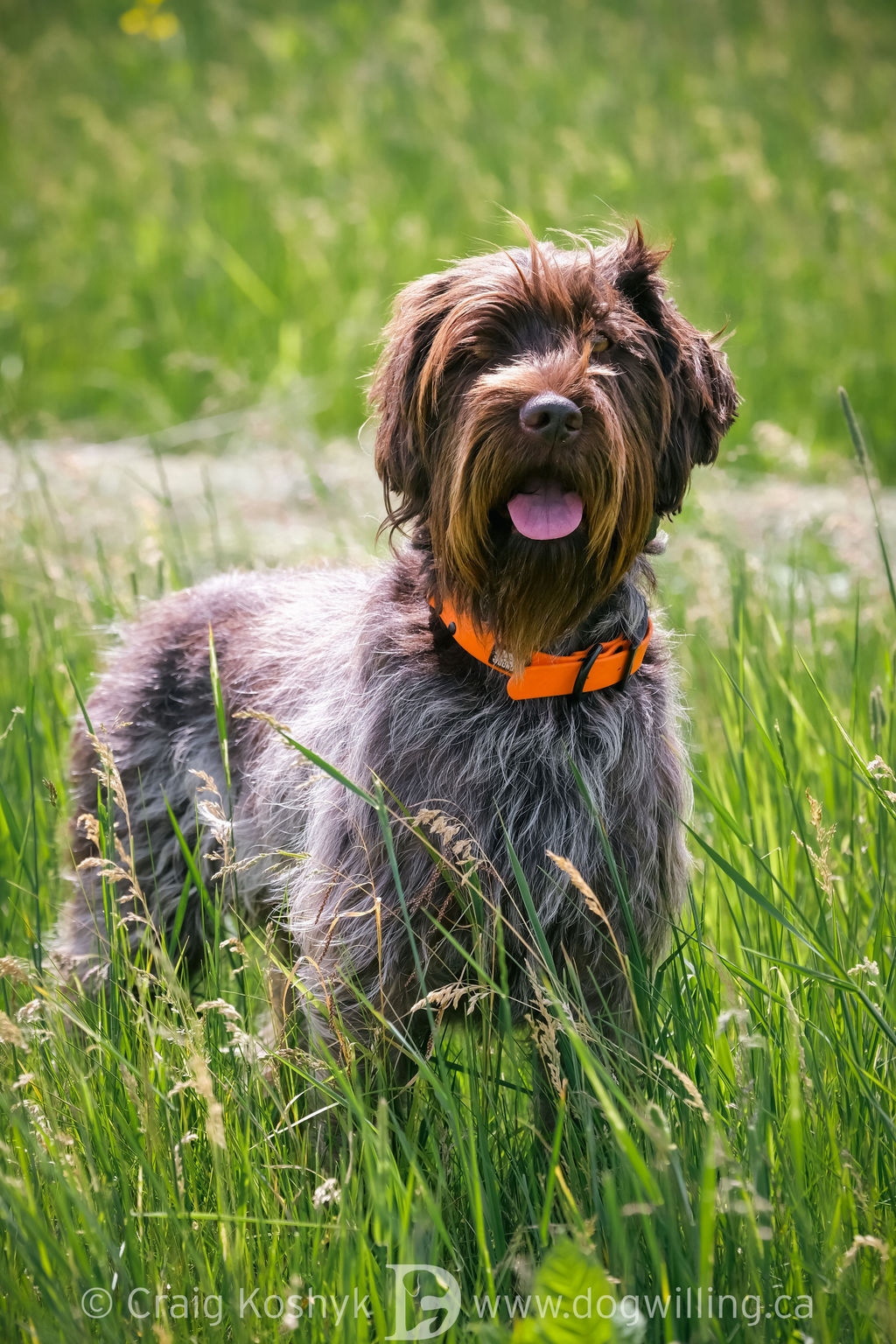
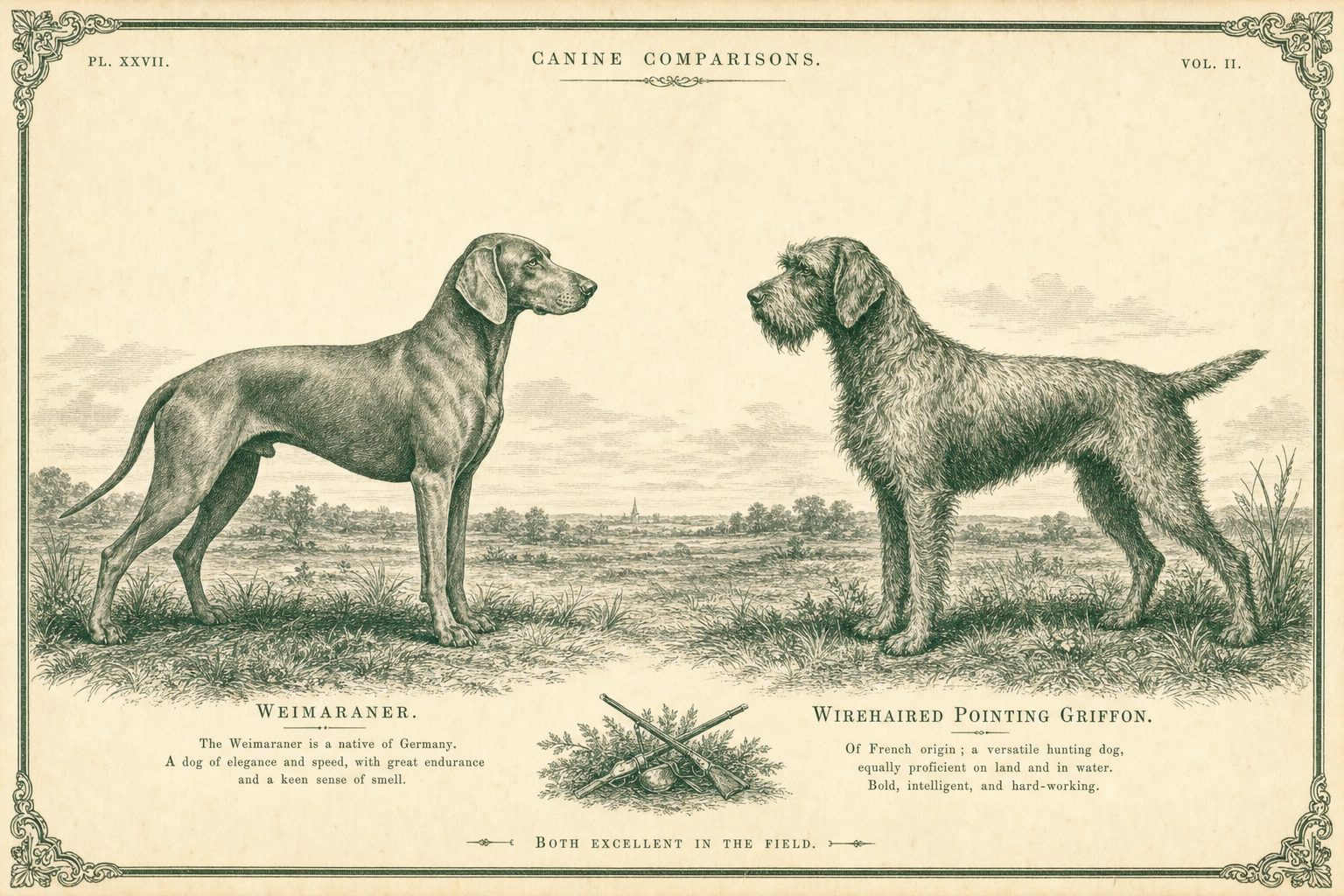
There is no breed in the gundog world with the visual presence of a Weimaraner. That silver‑grey coat, amber or blue‑grey eyes, and lean powerful build give the breed its famous nickname: the Gray Ghost. They haunt your every step — literally, the breed is known for following owners through the house room to room. If you’re drawn to the Weimaraner and also considering a Wirehaired Pointing Griffon, you’re looking at two very different personalities under the “continental versatile” label.
The Gray Ghost and the Korthals Griffon: both continental pointing dogs, very different demands.
The Weimaraner was originally bred in Germany for big game — boar, deer, bear — before being adapted to bird work. That heritage shapes everything about the breed’s energy, drive, and temperament. According to Project Upland’s Weimaraner profile, the breed can range from a hard‑hunting, serious gun dog to a high‑energy basket case depending almost entirely on lines and management. Source matters more for Weims than for almost any other breed on this list.
Hunting Style: Drive and Range
The Weimaraner is primarily an upland bird dog in North America today, though German lines retain significant tracking and big‑game capability. Project Upland notes that even the widest‑ranging Weimaraners are not run‑offs — they keep a sharp eye on their owners and willingly hunt for the gun. That’s different from a GSP or English Pointer at the wide end of the range spectrum. Most Weims hunt at a close‑to‑medium range with some field‑trial dogs running wider.
The pointing instinct can take time to develop in younger Weims. Retrieving, however, is one of the most deeply seated traits in the breed — Project Upland describes it as almost impossible to breed out. Even non‑hunting Weimaraners often retain a strong retrieve drive. If you want a pointing dog that also loves a game of fetch more than anything else, the Weim delivers.
The WPG hunts at a medium range with a close‑working style built for the walking hunter in heavy cover. Its feline “Korthals Cat” point is unmistakable. Where the Weimaraner was bred for German hunting traditions including big game, the WPG was designed specifically by Eduard Korthals to be the ultimate on‑foot versatile hunting companion — upland, wetlands, retrieve, track, in one manageable package.
Both breeds handle upland well. For late‑season cold‑water waterfowl, neither the standard short‑haired Weimaraner nor the WPG is a cold‑water powerhouse, though the WPG’s harsh double coat gives it an edge.
Interactive Tool
Which test or trial should your dog do next?
Answer a few quick questions about your dog’s age, training and your goals. We’ll point you to the right next step — NAVHDA, an AKC hunt test or field trial, a UKC or NSTRA title, or the conformation ring.
The Gray Ghost at Home
The Weimaraner’s Velcro intensity is not a rumor. The breed forms an extreme attachment to its owner — “not the kind of dog that can be left to their own devices around the house,” as the Wikibooks Weimaraner profile puts it. Weims are not suited to kennel life. They howl, bark, and destroy when bored, isolated, or under‑exercised. Separation anxiety is common and can be severe.
The WPG is also affectionate and closely bonded, but its Velcro factor is moderate rather than extreme. A WPG does better with reasonable daily separation than a Weimaraner typically does. If your household has people home most of the day and you hunt regularly, both dogs can thrive. If you work full‑time away from the house, the Weim’s separation demands are a serious practical consideration.
Energy and Training
The Weimaraner needs 60–90 minutes of vigorous activity daily — among the highest demands of any pointing breed. An under-exercised Weim is a house‑wrecker. The breed can range from eager‑to‑please (softer American field lines) to hard‑headed and strong‑willed (German lines described as “scary‑smart”). Project Upland puts it plainly: for every decent, hard-hunting Weimaraner, there are many others that range from mediocre to completely useless in the field. The breed’s striking looks attracted massive non‑hunting breeding pressure over decades.
The WPG requires 45–75 minutes of vigorous daily exercise — substantial, but less extreme than the Weim’s floor. The WPG’s softer temperament rewards patience over force; a WPG that’s pushed too hard shuts down. The Weimaraner, depending on lines, may handle more training pressure — but getting the lines right is everything.
Size, Coat, and Health
The Weimaraner is a larger dog than the WPG. Males run 23–27.5 inches and 65–85 lb; WPG males run 23–26 inches and 55–69 lb. The short‑haired Weimaraner (the vast majority) sheds low to moderate and requires almost no grooming — a real advantage. The WPG’s wire coat is lower‑shedding overall but needs hand‑stripping twice a year.
Weimaraner health includes some serious considerations. Bloat (GDV) is particularly common and dangerous in the breed. Hypertrophic osteodystrophy (HOD) — a severe, sometimes fatal inflammatory condition in puppies — is breed‑specific. The Weimaraner Club of America recommends splitting parvo and distemper vaccinations due to documented autoimmune reactions. Von Willebrand’s disease, hip dysplasia, and hypothyroidism are also present. Lifespan is 10–13 years, which is shorter than the WPG’s 12–14 years. Discuss vaccine protocols with your veterinarian before bringing a Weim pup home. Recommended health tests include OFA hips, cardiac, eyes, and thyroid.
The WPG’s health program is maintained by the AWPGA, requiring OFA hips, elbows, thyroid, and annual ACVO eye exams. Bloat risk exists in the WPG as well given the deep chest, but it is not as specifically documented as in the Weim.
Which Dog Fits You?
The Weimaraner is a spectacular dog for the right owner: experienced, active, home often, hunting regularly, and committed to a dog‑centered lifestyle. The Gray Ghost’s mystique is real, and a well‑bred Weim from hunting lines is a capable, loyal, and breathtaking hunting partner. But this breed demands a serious owner — there is very little margin for passive management.
The WPG asks less of its owner in terms of raw energy and emotional intensity, while still delivering genuine versatile gundog capability. It’s the better fit for a hunter who wants a close‑working partner with a forgiving temperament and a wire coat that handles Montana brush and cold water. Read more about the WPG’s background here, and browse our full gundog comparison series for more breed breakdowns. The WPG vs Vizsla post covers another intensely Velcro breed worth comparing.
How this article was made: researched and written with AI, then reviewed, edited, and published by Griffons Out West in Belgrade, Montana.