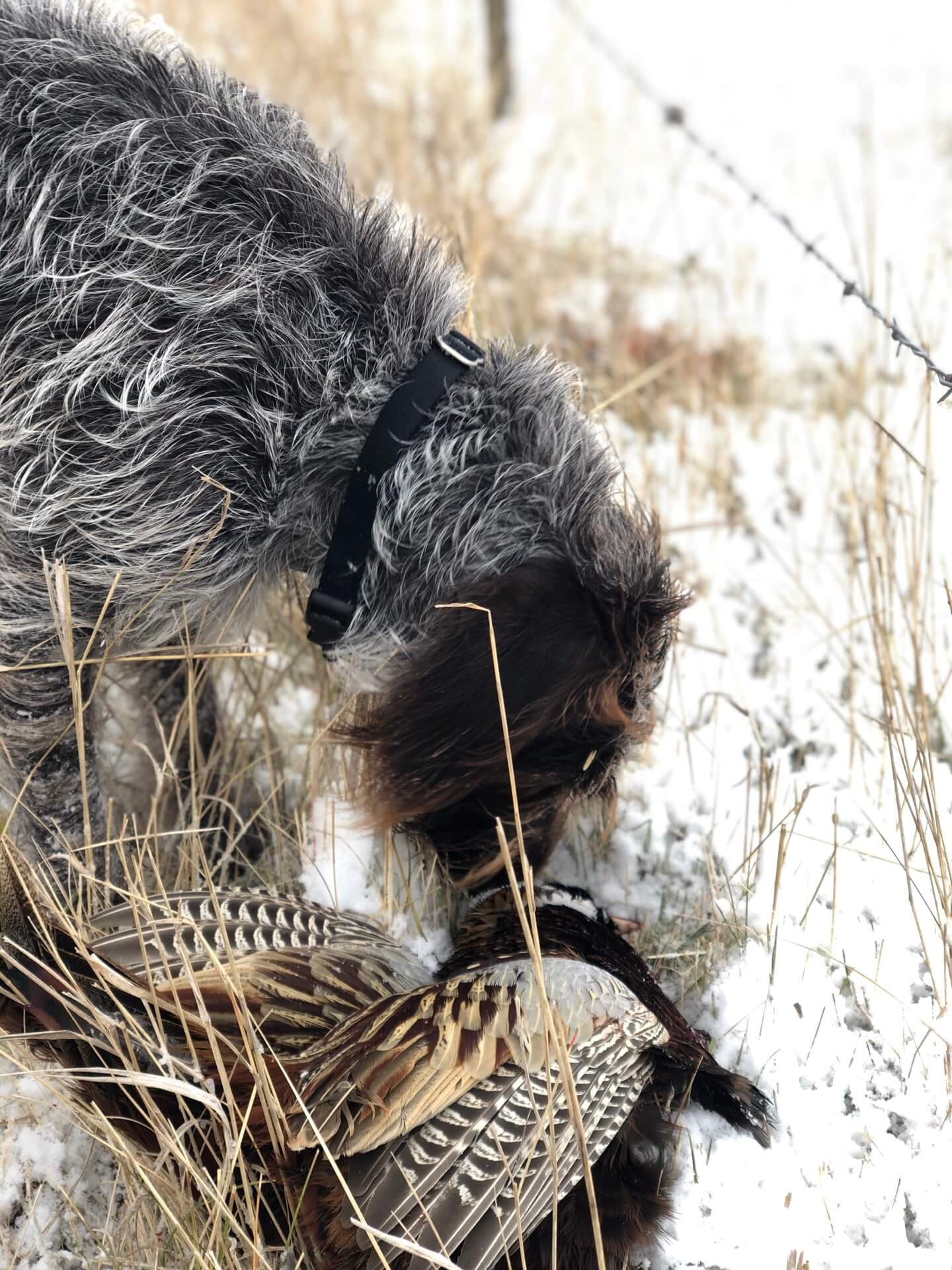
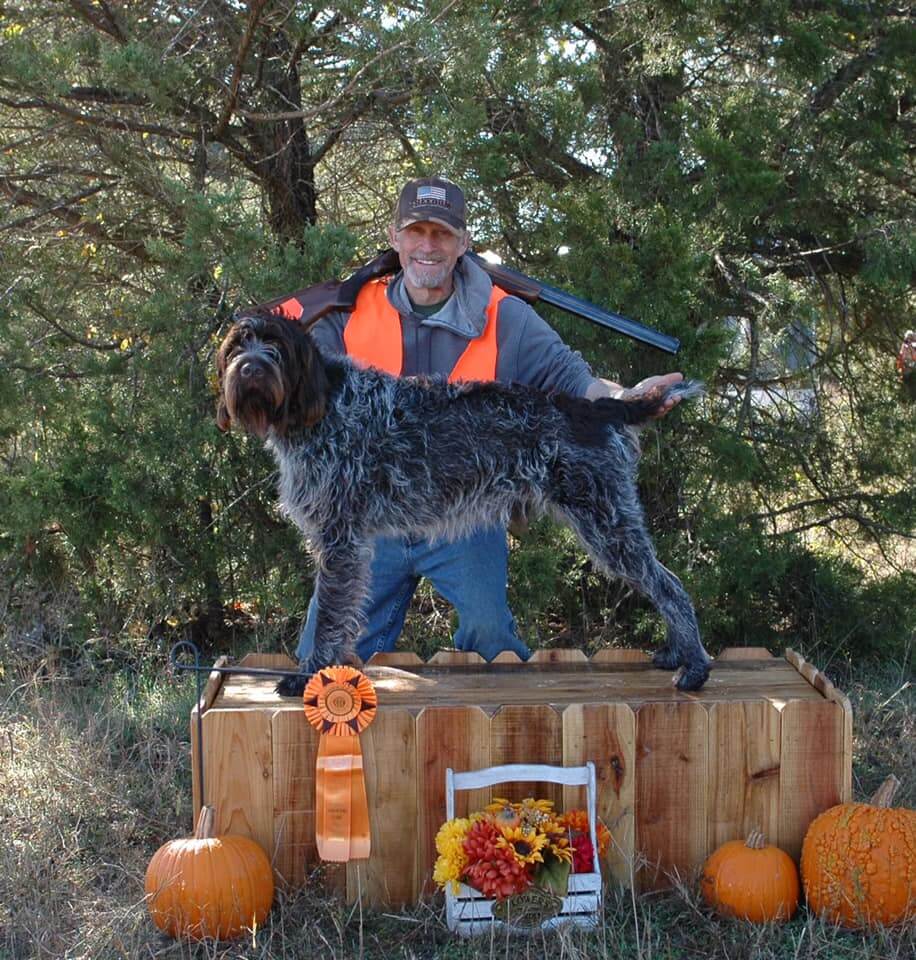
Of all the competitive bird-dog games in this series, the National Shoot to Retrieve Association — NSTRA — comes closest to feeling like an actual day in the uplands. It is a walking trial: no horses, no far-flung courses. Handlers carry their own shotguns and shoot their own birds over their own dogs. For a Wirehaired Pointing Griffon owner who wants to compete in the breed’s natural style, NSTRA is the most natural fit there is. This is the sixth post in our Field Tests & Trials series.
Make no mistake about its nature, though: NSTRA is a competitive field trial. All pointing breeds compete head to head, and only the top dogs of the day score points. But because it is run on foot at hunting range, with the handler doing the shooting, it rewards exactly the close, biddable, bird-finding work a Griffon is built for — unlike the wide-open horseback AKC All-Age trials.
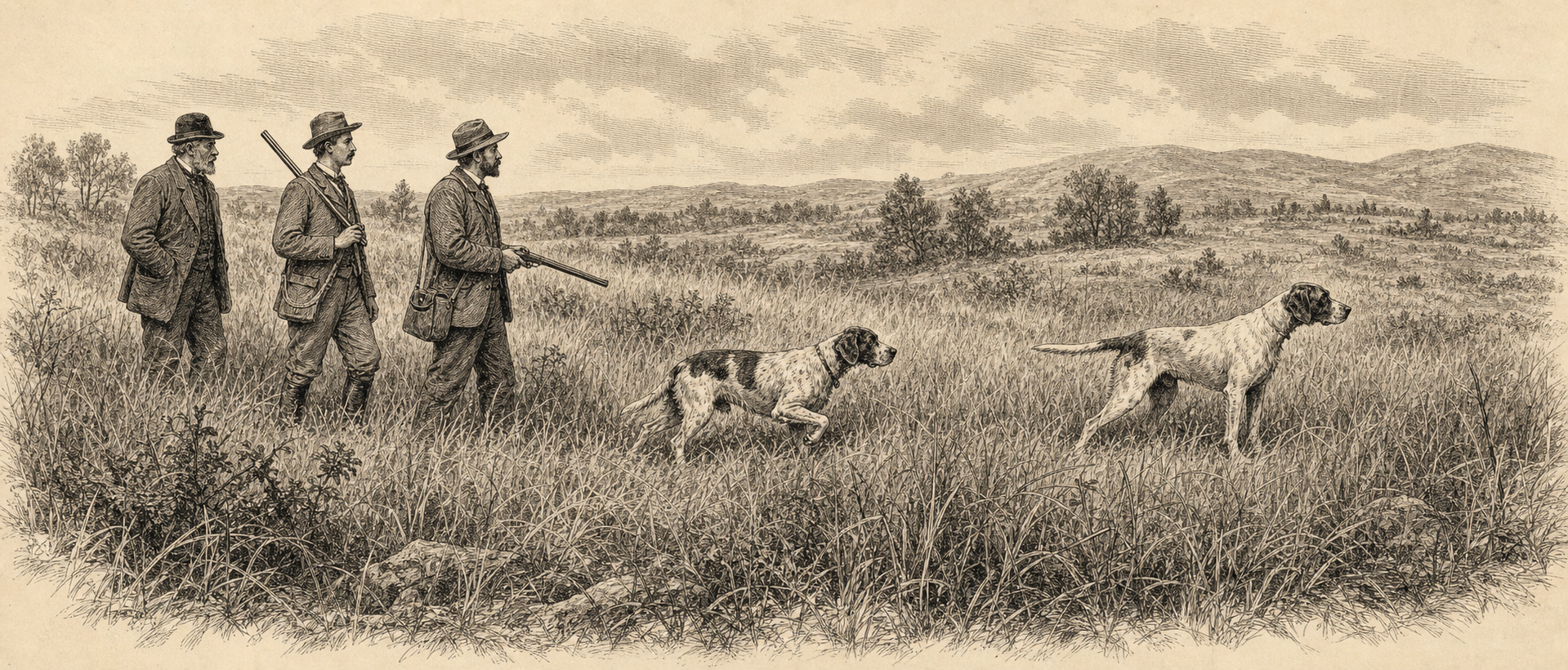
A Program Built Around the Hunt
NSTRA was founded in 1978 (the idea had been brewing since the late 1960s) and today runs as a nonprofit with 31 regions across the continental United States and Canada, hosting over 1,000 local field trials a year. It is open to any pointing breed registered with the AKC, UKC, FDSB (American Field), or the Canadian Kennel Club. The format closely simulates a real upland hunt, which is precisely why it has such a devoted following among working-dog people.
Here is a clear, first-hand explanation of how a NSTRA trial is set up and judged — the braces, the planted birds, the scoring on finds and retrieves — from handlers who run the circuit.
How a Trial Runs
Dogs compete in braces — randomly drawn pairs — and each brace runs 30 minutes in a designated field with birds planted in it. Each dog-and-handler pair is assigned its own judge, and the judges switch dogs at the fifteen-minute midpoint so every dog is seen by both. A typical trial fields 24 to 32 dogs, and a single weekend often hosts four trials — an A field and a B field on both Saturday and Sunday. It is a lot of bird work packed into two days.
How Dogs Are Scored
Scoring is granular and rewards productivity. Finds and retrieves are scored per bird; obedience, ground coverage, and backing are scored once per brace.
| Category | Score range | What is evaluated |
|---|---|---|
| Find (per bird) | 0–100 | Style, intensity, the slam point, game location, working the scent |
| Retrieve (per bird) | 0–100 | Speed, pick-up, return to the handler, delivery |
| Obedience | 0–75 | Responsiveness to the handler throughout the brace |
| Ground Coverage | 0–100 | Thoroughness of the search, quartering pattern, hunting application |
| Back (if opportunity) | 0–75 | Honoring a pointing bracemate immediately on sight |
Source: NSTRA trial rules.
Every bird that is found on a solid point, then shot and retrieved, is worth up to 200 points — 100 for the find and 100 for the retrieve. The math is simple and brutal: the dog that finds and cleanly retrieves more birds, with more style, generally wins the day. All category scores are summed, and the highest-scoring dog is declared the winner, with the top three placed.
If a dog never has the chance to see its bracemate on point, the back score is simply left blank — no penalty. But a score of 0 means the dog did see a pointing bracemate and refused to honor, and that is a real, meaningful deduction. Backing matters in NSTRA in a very concrete way, as we will see.
Becoming a NSTRA Champion
Points are awarded by placement, scaled to the typical 24–32 dog trial:
| Placement | Points |
|---|---|
| 1st place | 3 |
| 2nd place | 2 |
| 3rd place | 1 |
| 1st in Regional Elimination or NSTRA Championship finals | Counts as 1st-place points |
Source: NSTRA.
A dog earns NSTRA Champion status by accumulating 18 points total, of which at least 9 must be first-place points — and, critically, the dog must have demonstrated the ability to back. A dog that has never been observed honoring a bracemate’s point will not be certified as a Champion, no matter how high its point total climbs. Beyond the first championship, a dog can earn another for each additional 18-point accumulation (with 9 first-place points each), and champions are recorded permanently.
You are scored against the field, but you win by hunting — finding more birds, retrieving them clean, and honoring your bracemate. It is the trial that most resembles the thing the dog was actually bred to do.
At the top sit five National Championship Trials each year, including the “Trial of Champions” and the “Dog of the Year” event held in Amo, Indiana. Many regions also run an amateur program, letting a dog earn an amateur championship before stepping up to open competition.
The Honest Fit for a Griffon
NSTRA is a genuinely excellent road for a Griffon owner who wants to compete. The walking format, handler-shot birds, and close-range judging match the breed’s working style far better than wide-open horseback trials. One caveat, in keeping with the honesty this library is built on: NSTRA does not include a separate tracking leg or judge the full versatile picture, so it complements NAVHDA rather than replacing it. For competitive trialing in a Griffon’s natural idiom, though, it is hard to beat. The series closes with the bench side of the sport, AKC conformation.