Every program we have covered so far asks the same question in different ways: can this dog do the work? Conformation asks a different one entirely: is this dog built the way a Wirehaired Pointing Griffon should be built? A bench show is a competition of structure and type, judged against the written breed standard, and it is wholly separate from field and performance events. For a working breeder, it answers a question the field cannot — and leaves one it never touches. This is the seventh and final post in our Field Tests & Trials series.
What Conformation Actually Judges
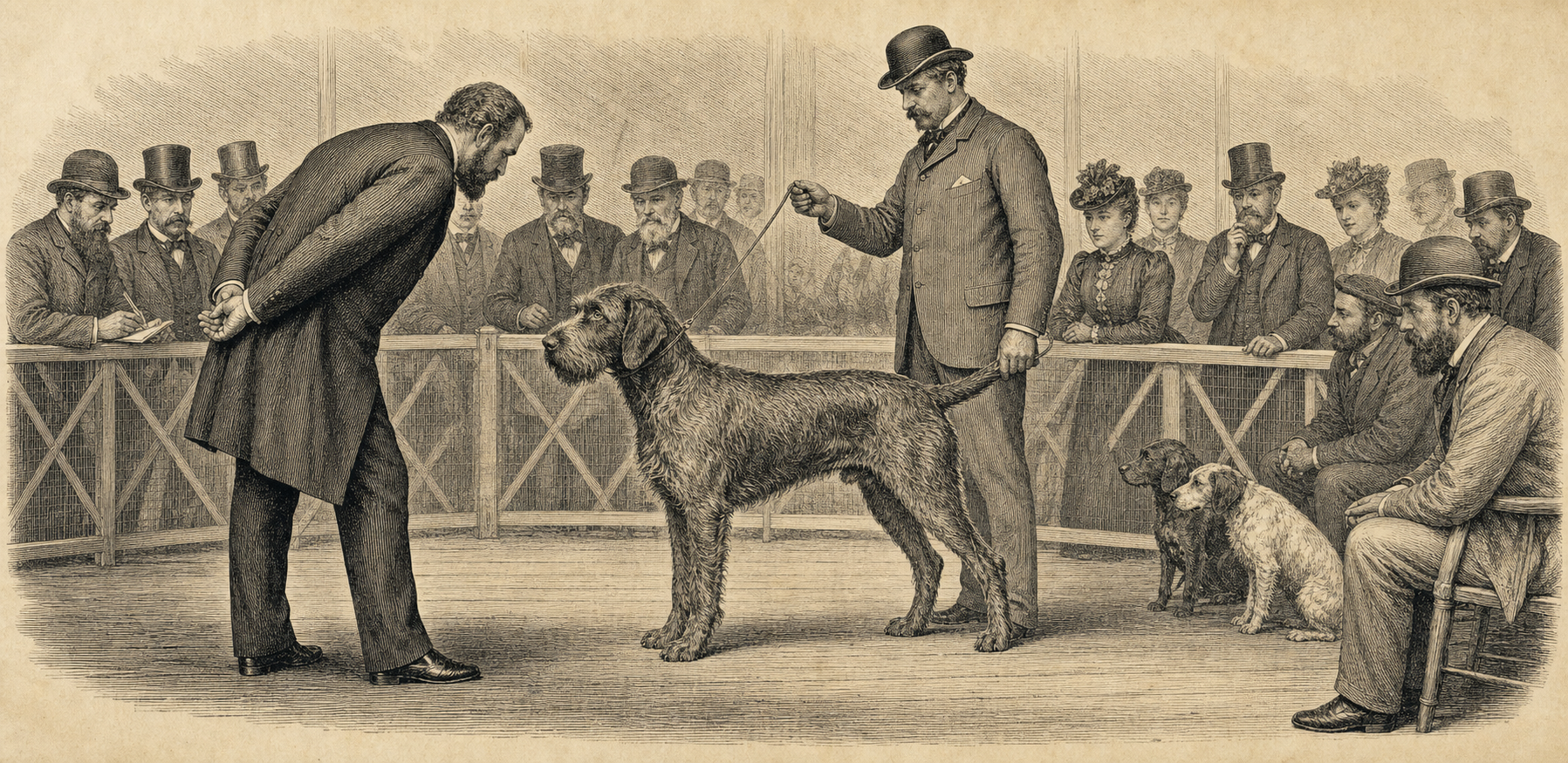
Dogs of the same breed compete before a single judge approved for that breed, who evaluates how closely each dog’s structure, movement, coat, and temperament match the breed standard. Two things happen in the ring. In the stack, the dog stands still while the judge goes over it by hand — shoulder and hip angles, the planes of the head, dentition, coat texture and density, and, in males, the presence of both testicles. In the gait, the dog is moved at a trot so the judge can assess its movement coming, going, and from the side. For a Griffon, the standard prizes the characteristic harsh, wiry double coat, the distinctive beard and eyebrows, overall balance, and the structural correctness of a foot-hunter.
The Wirehaired Pointing Griffon breed standard carries two breed-specific disqualifications. A dog with either trait cannot earn a single point, no matter how sound it is otherwise — the judge is required to mark it disqualified and excuse it from the ring:
- A nose any color other than brown. The Griffon’s nose is always brown, regardless of coat color. A black, slate, pink, or self-colored nose is an automatic DQ.
- A black coat. Acceptable colors are steel gray with brown markings, chestnut brown, roan, and white-and-brown; white-and-orange is allowed but less preferred. Black is disqualifying.
If you are planning to show, confirm nose color and coat at the source — these are the first two things a knowledgeable Griffon judge will check.
Source: AKC Sporting Group Breed Standards (official); corroborated by the AWPGA Judges’ Education packet.
Who Can Enter: Registration and Eligibility
Before a Griffon ever steps in the ring, it has to clear a short list of eligibility requirements. Conformation is open to any dog of an AKC-recognized breed that meets all of the following:
| Requirement | What it means for a Griffon |
|---|---|
| Full AKC registration | The dog must be individually registered with the AKC on full registration. A dog on Limited Registration is not eligible to compete in conformation — limited status specifically bars it from the breed ring. (Foreign-registered dogs may compete for up to 30 days while their AKC paperwork is processed.) |
| At least 6 months old | Puppies enter the day they turn six months; there is no upper age limit. |
| Intact (not spayed/neutered) | Because the sport evaluates breeding stock, dogs must be unaltered. In males, the judge confirms both testicles are present and descended. |
| No disqualifying faults | For a Griffon, that means a brown nose and no black in the coat (see above), plus none of the standard’s general DQs. |
| Healthy and current | Sound condition and up-to-date vaccinations as required by the host club. |
| Entered in advance | You must register the entry through the show’s superintendent, usually a few weeks before the event — you cannot simply show up on the day. |
Source: AKC Conformation and Conformation 101.
For a clear, official explanation of how a dog show is structured and what conformation judging is really measuring, the American Kennel Club’s own primer is the best starting point.
How Dogs Earn Points
Dogs and bitches compete separately through a series of regular classes — Puppy (6–9 and 9–12 months), 12–18 months, Novice, Amateur-Owner-Handler, Bred-by-Exhibitor, American Bred, and Open. The class winners of each sex then meet to award Winners Dog and Winners Bitch, and those two wins earn championship points. The number of points depends on how many dogs of the same sex and breed were defeated, with a maximum of 5 points per show. A win worth 3, 4, or 5 points is called a major — the hardest and most important kind to come by.
Which Class Should Your Griffon Enter?
The regular classes are not skill levels — they are eligibility categories based on the dog’s age, who owns and handles it, and how it was bred. Because every class winner advances to the same Winners competition, the goal is simply to pick the class you legitimately qualify for that gives you the best draw. Here is how to read them for your own dog:
| Class | Enter if… |
|---|---|
| Puppy 6–9 months | Your Griffon is between 6 and 9 months old on show day. |
| Puppy 9–12 months | Your Griffon is between 9 and 12 months old. |
| 12–18 months | Your Griffon is between 12 and 18 months — a good landing spot for an adolescent dog. |
| Novice | Your dog has not yet won three first places in Novice, a first in Amateur-Owner-Handler / Bred-by-Exhibitor / American-Bred / Open, or any championship points. A gentle on-ramp for a green dog or handler. |
| Amateur-Owner-Handler | You will personally handle the dog, you own (or co-own) it, and you have never been a professional handler, AKC judge, or paid handler’s assistant. Levels the field for owner-handlers. |
| Bred-by-Exhibitor | You bred the dog and you (or an immediate family member) both own and handle it — the breeder’s showcase class. The natural choice for a Griffon you produced yourself. |
| American-Bred | The dog was born in the U.S. from a sire and dam that were mated in the U.S. |
| Open | Open to any eligible dog of the breed. This is the only regular class a finished Champion may enter, and it is typically the most competitive — the deepest, most polished dogs land here. |
Source: AKC — Selecting a Conformation Class.
A practical reading for most Griffon owners: if you bred the dog, Bred-by-Exhibitor is the proud and natural home. If you bought a young prospect and handle it yourself, Amateur-Owner-Handler or the age-appropriate puppy class is the easiest entry. Once a dog is mature and competitive, many exhibitors move it to Open, where the strongest dogs gather and majors are most often won — just remember that, once finished, Open is the only regular class your new Champion can return to.
Champion of Record (CH)
The foundational title is Champion of Record, carried as the prefix CH. It requires:
| Requirement | Detail |
|---|---|
| Total points | 15 championship points |
| Majors | At least 2 majors (3-point or higher wins) |
| Judges | The 2 majors under at least 2 different judges |
| Additional | At least 1 more point under a 3rd different judge |
Source: AKC Conformation 101.
Grand Champion (GCH) and Beyond
After finishing the CH, a dog enters Best of Breed competition to earn Grand Championship points, which are tallied separately. Earning the GCH prefix requires 25 Grand Championship points, 3 majors under 3 different judges, points won under at least 4 different judges in all, and the defeat of at least one existing Champion of Record at three of those shows. Beyond the initial GCH, the title stacks through metallic levels as a dog keeps winning at the breed level.
| Level | Total GCH points required |
|---|---|
| GCH Bronze (GCHB) | 100 |
| GCH Silver (GCHS) | 200 |
| GCH Gold (GCHG) | 400 |
| GCH Platinum (GCHP) | 800 |
Source: AKC Grand Championship points.
What Conformation Means for a Working Breeder
For a breeder committed to the Griffon’s full working heritage, the bench serves a specific and genuine purpose: it verifies structural soundness and type against the standard. A dog that looks the part — correct coat, proper proportions, sound movement — should, in theory, also hold up to a hard season afield. That is the whole premise of a breed standard built around function.
But we will be just as honest here as everywhere else in this library: conformation alone says nothing about a dog’s hunting ability. A dog can finish its championship without ever finding a bird. For a working breeder, a bench title is one component of a balanced evaluation — never the sole measure of a breeding dog’s worth.
The field tells you what a dog can do. The bench tells you whether it is built to keep doing it. Neither, alone, tells you enough.
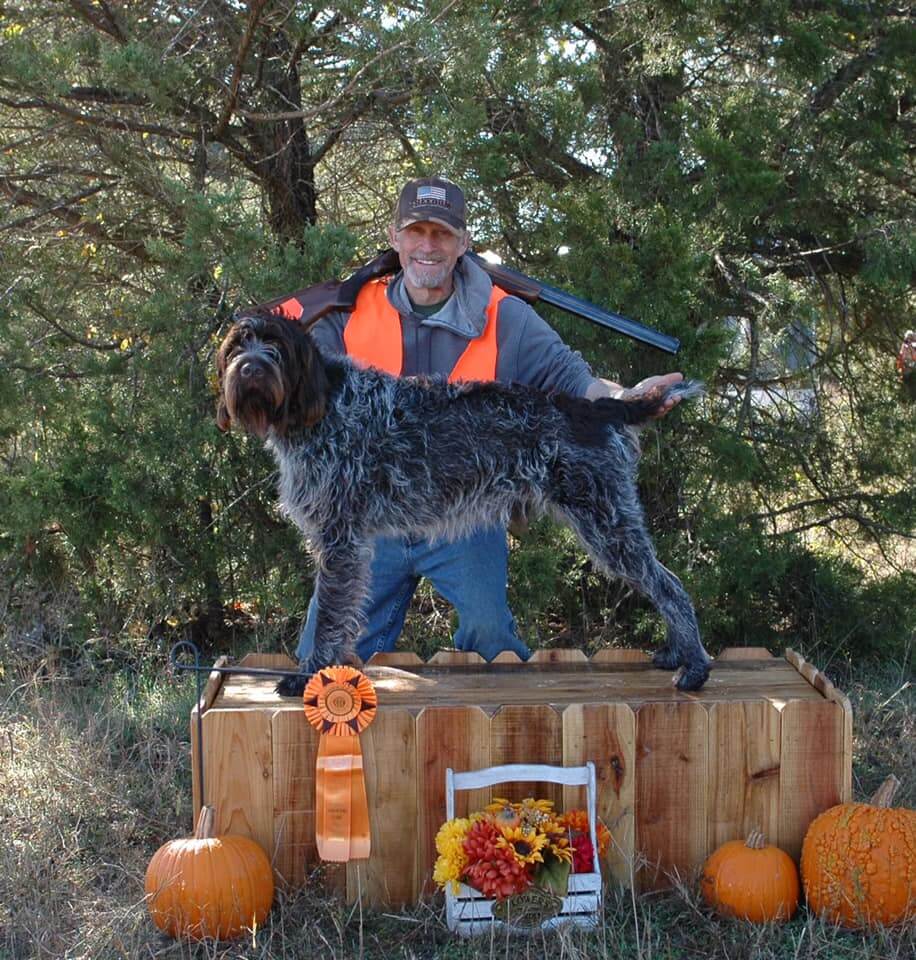
That is exactly why the most respected awards in the breed demand both. The AWPGA’s top honor, the Versatile Excellence Award, requires an AKC Grand Champion title plus one of: AKC Master Hunter, NAVHDA Versatile Champion, AKC Field Champion, or Amateur Field Champion. A dog like VC GCHB CH Aux Lake Rum Tum Rudy MH — a past AWPGA Field Dog of the Year — wears both the bench and the field on the same name, which is the whole point: in this breed, beauty and function are meant to be inseparable.
Bringing the Series Together
That closes our tour. We have walked the difference between a test and a trial, the breed’s home system in NAVHDA, the AKC hunt test ladder, the competitive AKC field trials, the hybrid UKC pointing program, the hunt-like NSTRA, and now the bench. Taken together, they map every recognized way to prove a Wirehaired Pointing Griffon — in the field and in the ring.