The Griff Life: What It’s Really Like to Live With a Wirehaired Pointing Griffon
Now Booking
Spring 2027 Litter
Pepper · Dam
Walker · Sire
✓Health-tested, CHIC-certified parents
✓AKC, UKC, & NAVHDA registered
✓Titled, proven hunting bloodlines
✓Raised in-home for 10 weeks
Limited spots · Screening required
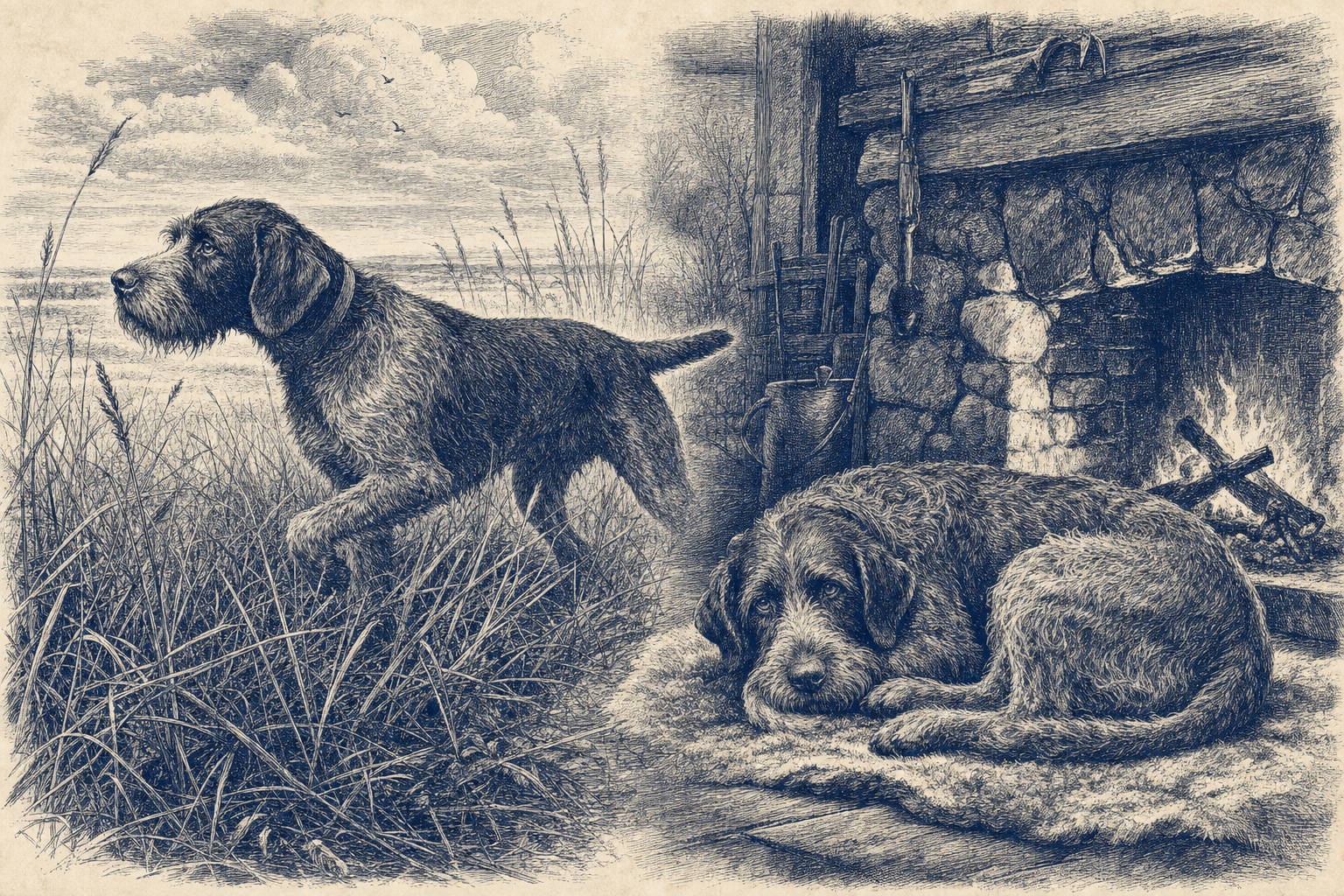
Ask a man who has owned one what a Wirehaired Pointing Griffon is really like, and he will usually pause, smile a little, and tell you two stories. One is about the dog welded to a covey of birds in a cutbank at last light, trembling on point, all business. The other is about the same dog asleep on his feet an hour later, beard full of burrs, snoring by the woodstove like he owns the place. Both stories are true. The whole character of the breed lives in the space between them.
That dual nature — an intense, biddable hunter afield and an affectionate, almost comically devoted housedog at home — is exactly what Edward Korthals built the breed to be. If you want to understand where that temperament came from, read how Korthals made the breed; if you want to know what the written standard asks of it, see our breed standard deep-dive. This article is about the living dog — what it is actually like to share a truck cab, a duck blind, and a couch with one.
Two halves of the same dog: all business in the grass, all heart by the fire.
The Temperament the Standard Asks For
This is not a soft-focus marketing claim — the breed’s gentle, intelligent disposition is written into the official standard itself. The American Kennel Club describes the Griffon’s temperament as that of a dog that loves to work, easy to train, and very loyal to its master, and the breed standard calls for a dog that is tractable and easy to train. More than a century ago, the breed’s American champions said it better than any modern copywriter could.
The chief characteristics in which the griffon excels … are his ready adaptability to all species of game, all climates, and all varieties of terrain, his exquisite nose, wonderful vitality and endurance, and the pronounced instinct which makes him the easiest of all dogs to train on game … and being very intelligent and affectionate, he makes an ideal man’s companion.
That was Dr. E.B. Ilyus, first secretary of the Griffon Club of America, writing in 1917. A hundred years on, it still reads as the truest single paragraph anyone has written about the breed.
The short version of Griffon character
Devoted, not distant. The Griffon is a Velcro dog. It wants to be with its people, in the house, underfoot. This is not a kennel-and-forget breed.
Biddable and sensitive. It trains easily and reads your mood — which also means it does not take well to heavy-handed correction. It wants to please.
Calm in the house, fierce in the field. A well-exercised Griffon is famously mellow indoors and switches on the moment boots hit the truck.
Good with family. Generally excellent with children and, when raised right, with other dogs.
Interactive Tool
Which test or trial should your dog do next?
Answer a few quick questions about your dog’s age, training and your goals. We’ll point you to the right next step — NAVHDA, an AKC hunt test or field trial, a UKC or NSTRA title, or the conformation ring.
In the Field: What You Are Actually Getting
The Griffon is a close-working, foot-hunter’s gun dog — not a wide-ranging horseback dog. Korthals wanted a dog a walking hunter could keep in front of him all day, and that is what the breed still is. It quarters methodically within gun range, points staunchly, honors a bracemate, and — the trait the breed is prized for — retrieves naturally and tenderly from land and water. The harsh, wiry coat is not cosmetic; it is a working tool that lets the dog crash through cattail, brush, and cold marsh that would stop a thinner-coated breed.
It is, in the truest sense, a versatile breed: built to find upland birds, sit a duck blind, and track a wounded bird through cover, all in the same morning. That is precisely why the breed has a natural home in the versatile-dog testing world — if you want to prove yours, our companion guide to NAVHDA and the broader Heritage & Registries series lay out every path.
Know this going in: it is a high-drive working breed
A Griffon is a wonderful housedog because its needs are met — not instead of meeting them. This is a hunting dog with real engine. Without regular, vigorous exercise and some kind of work for its mind, a bored Griffon will find its own projects, and you will not like them. If you are not going to hunt, train, or otherwise burn that drive several times a week, this is the wrong breed, no matter how charming the beard is.
At Home: The Beard on the Couch
Here is the part that surprises people who only know the breed’s field reputation: indoors, a Griffon is one of the easiest dogs to live with. A mature, exercised Griffon is quiet, undemanding, and content to be wherever you are. They are clownish and affectionate, they bond hard to the whole family, and they have a wonderful tolerance for the chaos of children. The wiry coat sheds far less than most breeds, which earns the Griffon its reputation as a relatively low-shedding housedog — though that same coat needs regular hand-stripping or trimming and a beard that, fair warning, will deliver a cupful of water to your kitchen floor after every drink.
Below is a short, clear look at the breed’s temperament and what living with one really involves, straight from breed-club educators.
Is the Griffon Right for You?
The breed sorts its owners quickly. It is a superb fit for an active person or family who will give it a job — hunting, field training, or serious daily exercise — and who wants that dog living inside as a full member of the household. It is a poor fit for someone wanting a low-energy apartment dog, an outdoor-only kennel dog, or a breed they can ignore on weekdays. The Griffon gives you everything it has; it expects the same back.
A note on our pups
Our Griffons are raised in-home for their first weeks specifically so this temperament develops the way it should — bonded to people, calm in a house, and switched-on in the field. Pups can be registered with AKC, NAVHDA, and UKC, and we handle AKC registration prepaid by default so your dog’s paperwork is squared away from day one. To see what that looks like in practice, read about the national breed community and the clubs we train with here in Montana.
You do not really own a Griffon so much as enter into a partnership with one. Hold up your end — the work, the training, the time — and it will hold up an end you did not know a dog could carry.
That is the breed in full: the staunch point and the snoring by the fire, the same dog wearing both. Once you have lived with one, no other kind of quiet feels quite as earned as a tired Griffon asleep at your feet after a hard day in the birds.
How this article was made: researched and written with AI, then reviewed, edited, and published by Daniel Hartzheim of Griffons Out West in Belgrade, Montana.
The temperament descriptions above draw on the official breed temperament from the American Kennel Club and the breed standard hosted by the American Wirehaired Pointing Griffon Association, along with the 1917 writing of Dr. E.B. Ilyus of the Griffon Club of America. Always meet the parents and talk to a reputable breeder before deciding whether the breed fits your life.