The Breed Standard, Read Five Ways: AKC, UKC, FCI, France & Canada
Now Booking
Spring 2027 Litter
Pepper · Dam
Walker · Sire
✓Health-tested, CHIC-certified parents
✓AKC, UKC, & NAVHDA registered
✓Titled, proven hunting bloodlines
✓Raised in-home for 10 weeks
Limited spots · Screening required
Spend a winter evening reading the breed standards for the Wirehaired Pointing Griffon and you come away with an odd feeling — like listening to five old men describe the same dog they all loved, each remembering him a little differently. One swears he stood two-and-twenty inches at the shoulder. Another measures him in centimeters and docks half an inch off the top. One will throw a dog out of the ring for a bad hip; another never mentions it. They are all describing the Griffon. They simply do not agree on every line of him.
That is not sloppiness. It is history. The breed was built in one place, refined in another, and adopted by kennel clubs on two continents that each kept their own books. If you want the story of how that happened, read how Korthals made the breed and how France saved and spread it. This article is the companion to those: a clear, side-by-side reading of what the five governing standards actually say — the American Kennel Club, the United Kennel Club, the Fédération Cynologique Internationale, the Club Français du Griffon Korthals, and the Canadian Kennel Club — where they line up, and where a perfectly correct dog under one book would be marked down under another.
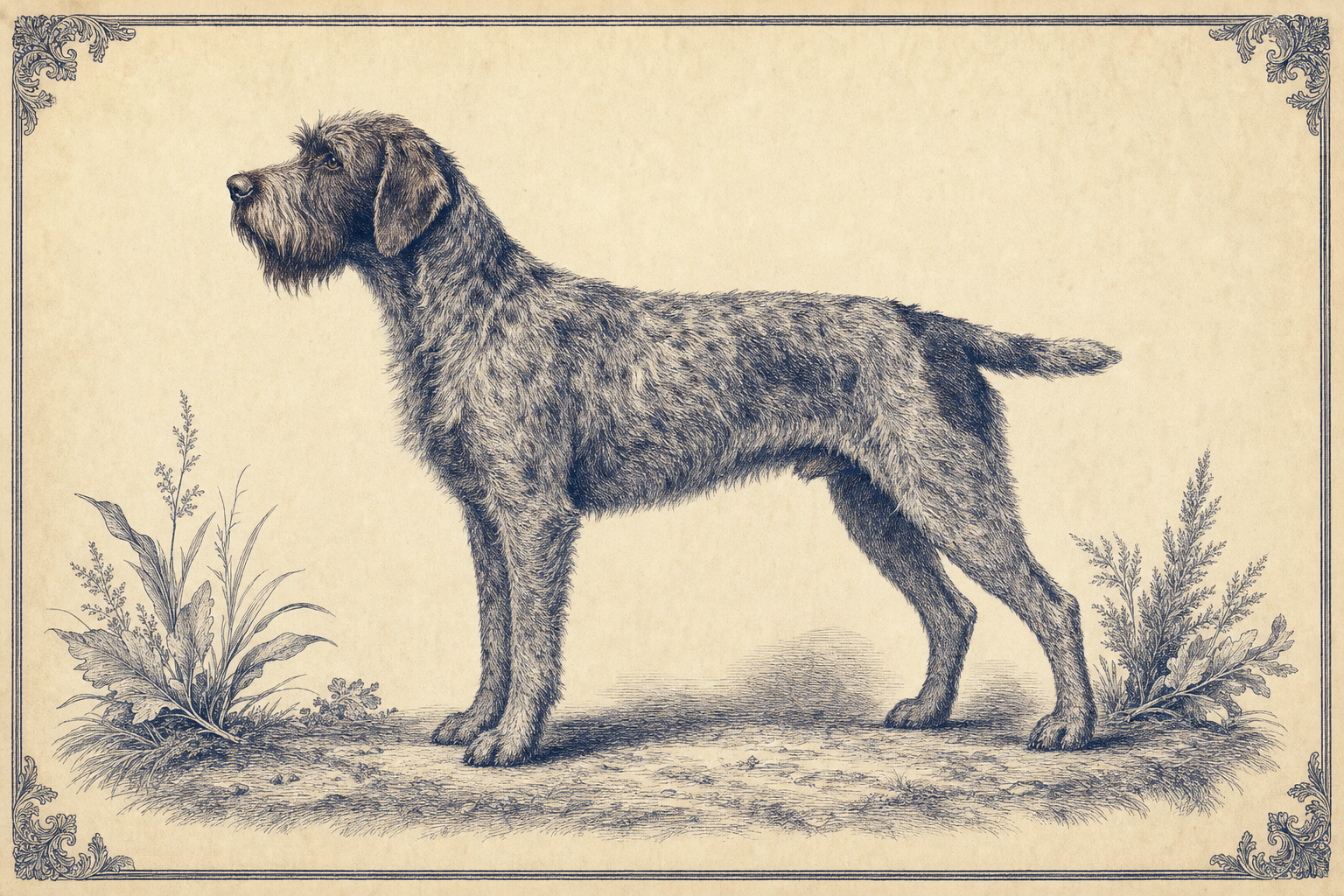
The Griffon as the standards describe him: square head, harsh double coat, abundant beard and eyebrows, slightly longer than tall.
Five Documents, One Dog
Before comparing lines, it helps to know who wrote what, and when. France is the breed’s country of origin, so the FCI standard is the parent document — the one all the others descend from. The definitive standard was first adopted on November 15, 1887; the Club Français was founded in 1901 and added “Korthals” to the breed name in 1951. The American and Canadian books came later and drifted, in places, from the original.
Registry
Document
Effective
AKC (USA)
Official AKC Breed Standard, hosted by the AWPGA
Approved 1991
UKC (USA)
Official UKC Breed Standard
Revised 2007
FCI (International)
FCI Standard No. 107 — the parent standard
Last updated 2023
Club Français
Standard de Conformité + “Points de Non-Confirmation”
1887 base; fault list 1982
CKC (Canada)
CKC Breed Standard — Griffon (Wire-Haired Pointing)
Strip away the national accents and a single, unmistakable dog stands underneath. On the things that make a Griffon a Griffon, the five books speak with one voice.
The breed, as all five standards define it
A harsh, double coat. Every standard demands a coarse, wiry outer coat — famously likened to “the bristles of a wild boar” — over a fine, dense undercoat. Curly or woolly is a fault everywhere.
A brown nose, always. All five say it outright. The nose is brown; any other color is a fault or a disqualification in every registry.
Steel grey with brown markings is the preferred color. It heads the color list in every single standard.
Black is out. No standard permits a black coat — some name it a disqualification, others exclude it simply by leaving it off the list.
Slightly longer than tall. A medium-sized dog, body a touch longer than its height at the withers, with a square head, abundant beard and eyebrows, scissors bite, and dark yellow or brown eyes.
No plume on the tail. Every book prohibits it.
If you only ever read one standard, you would still recognize a correct Griffon in any country on earth. The disagreements are real, but they live at the edges — in the inches, the docking, and the disqualifications. That is where it gets interesting.
Interactive Tool
Which test or trial should your dog do next?
Answer a few quick questions about your dog’s age, training and your goals. We’ll point you to the right next step — NAVHDA, an AKC hunt test or field trial, a UKC or NSTRA title, or the conformation ring.
The Inches Don’t Line Up
Here is the divergence that catches breeders by surprise. The American standard measures in inches and runs a little taller; the European and Canadian standards measure in centimeters and cap out lower. The gap is small — about a centimeter — but it is real, and it sits right at the top of the range.
Registry
Males
Females
Notes
AKC
22–24 in (55.9–61.0 cm)
20–22 in
Oversize “severely penalized”
UKC
21½–23½ in
19½–21½ in
Lowest minimum of the five
FCI
~55–60 cm (21.7–23.6 in)
~50–55 cm
“About” — approximate targets
Club Français
55–60 cm + tol. −1/+2 cm
50–55 cm + tol.
Tolerance stated for confirmation
CKC
55–60 cm (21.5–23.75 in)
50–55 cm
Aligns to FCI in metric
Read the top of those ranges carefully. The AKC’s ceiling for a male is 24 inches — 61 cm — which is a full centimeter above the FCI and CKC maximum of 60 cm. Put plainly: a 24-inch male can be a perfectly correct, even prizewinning dog under the AKC, and that same dog would be over-height — outside the standard — in a French confirmation ring. Run the other direction and the UKC’s 21½-inch minimum sits below the AKC’s 22-inch floor, so a small, FCI-legal dog could be marked under-size by the AKC. The breed Korthals built has not changed; the rulers measuring it have.
Tail docking is the next place the books part company — and it tells you something about the cultures behind them. The AKC docks the most aggressively. The European and Canadian standards take far less, and two of them explicitly refuse to penalize a dog wearing the tail it was born with, a nod to the many countries where docking is now banned outright.
Registry
Docking amount
Natural tail
AKC
One-third to one-half removed
No statement
UKC
Generally one-third removed
Shall not be penalized
FCI
A third or a quarter removed
Carried horizontally if left
Club Français
A third or a quarter removed
Tailless/bobtail = eliminating fault
CKC
Docked to two-thirds (one-third off)
Shall not be penalized
The AKC is the outlier, allowing up to half the tail to come off. The other four cluster tightly around one-third, with the European standards permitting as little as a quarter. If you are choosing a docked length for a litter, this is the line to know: a dock that satisfies the AKC could be longer than an FCI judge prefers, and shorter than what a docking-free country would even allow.
The Disqualifications: This Is Where the Books Truly Diverge
A disqualification is the standard’s hard line — the fault that doesn’t cost points but removes the dog from competition entirely. Compare the five DQ lists and you find the widest gap of all. The AKC names just two. The Canadian and French books name many. And the FCI — the parent of them all — names neither black coat nor a bad nose, leaving them excluded only by implication.
Disqualification
AKC
UKC
FCI
Club Fr.
CKC
Nose not brown
DQ
DQ
implied
implied
DQ
Black coat
DQ
DQ
implied
implied
DQ
Overshot / undershot
serious fault
—
—
DQ
DQ
Absence of undercoat
—
—
—
eliminating
DQ
Cryptorchid / monorchid
—
DQ
—
DQ
DQ
Viciousness / extreme shyness
—
DQ
DQ
DQ
serious fault
Ectropion / entropion / wall-eye
—
—
—
eliminating
DQ
Albinism
—
DQ
—
—
—
Tailless / short tail
—
—
—
eliminating
DQ
Hip dysplasia grade D/E
—
—
—
DQ (confirmation)
—
Size out of tolerance
—
—
—
DQ (confirmation)
—
Source: disqualification lists from the AWPGA, UKC, FCI, the Club Français, and the CKC (cross-checked against the CKC disqualifications booklet).
The two disqualifications every standard enforces
If you remember nothing else, remember these: a nose that is not brown, and a black coat. The AKC, UKC, and CKC name both as outright disqualifications. The FCI and the French club don’t list them by name — but because neither appears anywhere in the permitted color or nose descriptions, a black or wrong-nosed dog is just as out of standard there. These are the bright lines no Griffon can cross in any ring.
The faults that only some books punish
This is where a dog can be “correct” in one country and disqualified in another. An overshot or undershot bite is only a serious fault under the AKC — but a disqualification under both the CKC and the French club. The absence of an undercoat is uniquely a disqualification in Canada and an eliminating fault in France, yet goes unaddressed by the AKC and UKC. And the French club stands alone in disqualifying a dog for hip dysplasia grade D or E — a health screen baked directly into the confirmation system, found in no other standard. For the full picture of how the French run their selection, see our deep-dive on the cotation system.
The Telling Smaller Differences
A few quieter divergences are worth knowing, because they reveal what each registry chose to emphasize.
“Brown” versus “liver.” The AKC calls the color brown or chestnut; the UKC calls it liver throughout; the FCI and CKC hedge with “brown (liver)”; the French say marron. These are five words for one pigment — a translation difference, not a real one. Don’t let a vocabulary gap convince you the dogs are different.
The gallop. The FCI and French standards explicitly name the gallop as the breed’s primary hunting gait, with a “catlike” stalk as the dog walks up game. The AKC and CKC describe only the trot. The UKC has no gait section at all. It is a small line that captures a real difference in field culture — the continental view of a dog that ranges and gallops, versus the close-working trot emphasized in North American show language.
Webbed feet. Only the AKC explicitly names “tightly closed webbed toes” — a tip of the hat to the breed’s water-retrieving work. The others simply ask for round, tight, well-arched feet. The webbing is there in the dog regardless; the AKC just chose to write it down.
So Which Standard Is “Right”?
None of them, and all of them. The FCI standard is the original and the most recently revised, so it carries the most authority on what Korthals intended. But the AKC standard governs the ring most American owners will ever enter, and the breed it describes is unmistakably the same dog. A serious breeder reads them together — treating the FCI as the constitution and the national standards as the local statutes — and breeds to the dog all five agree on: the steel-grey, brown-nosed, harsh-coated, square-headed, foot-hunter’s gun dog with the beard full of burrs and the heart of a house pet.
We breed to the dog the standards agree on, and we prove it the way the standards intend — in the field and on paper. Our Griffons can be registered with AKC, NAVHDA, and UKC, and we handle AKC registration prepaid by default, so your pup’s paperwork is squared away the day it comes home. To see what the working side of that looks like, the conformation showing guide in our Field Tests library walks through exactly how a Griffon is evaluated against the written standard in the ring.
Five clubs, two continents, a hundred and thirty years — and still, when a good Griffon walks into the room, every one of those books would know him on sight. That is the mark of a breed worth getting right.
How this article was made: researched and written with AI from the primary source documents, then reviewed, edited, and published by Daniel Hartzheim of Griffons Out West in Belgrade, Montana.